
Eurovision Brighton 1974
Evening Argus (from Brighton), March 30 1974, UK. This is the local Brighton newspaper covering Olivia and the Eurovision Song Contest. Brighton, England was where the 1974 Contest was held.
Is this the winning team?
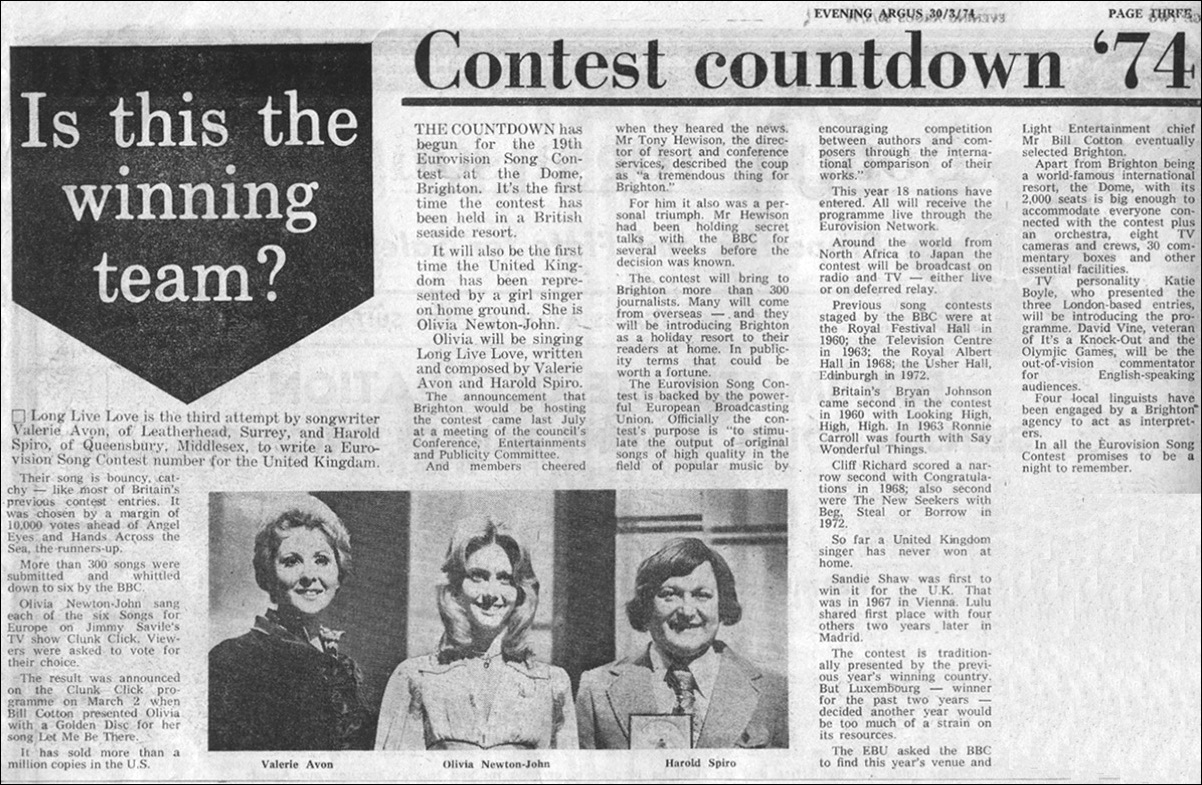
Long Live Love is the third attempt by songwriter Valerie Avon, of Leatherhead, Surrey, and Harold Spiro, of Queensbury, Middlesex, to write a Eurovision Song Contest number for the United Kingdom.
Their song is bouncy, catchy like most of Britain's previous contest entries. It was chosen by a margin of 10,000 votes ahead of Angel Eyes and Hands Across the Sea, the runners-up.
More than 300 songs were submitted and whittled down to six by the BBC.
Olivia Newton-John sang each of the six Songs for Europe on Jimmy Savile's TV show Clunk Click, Viewers were asked to vote for their choice.
The result was announced on the Clunk Click programme on March 2 when Bill Cotton presented Olivia with a Golden Disc for her song Let Me Be There. It has sold more than a million copies in the U.S.
Contest countdown '74
THE COUNTDOWN has begun for the 19th Eurovision Song Contest at the Dome, Brighton, It's the first time the contest has been held in a British seaside resort.
It will also be the first time the United Kingdom has been represented by a girl singer on home ground. She is Olivia Newton-John.
Olivia will be singing Long Live Love, written and composed by Valerie Avon and Harold Spiro. The announcement that Brighton would be hosting the contest came last July at a meeting of the council's Conference, Entertainments and Publicity Committee. And members cheered when they heard the news. Mr Tony Hewison, the director of resort and conference services, described the coup as a tremendous thing for Brighton.
For him it also was a personal triumph. Mr Hewison had been holding secret talks with the BBC several weeks before the decision was known.
The contest will bring to Brighton me more than 300 journalists. Many will come from overseas and they will be introducing Brighton as a holiday resort to their readers at home. In publicity terms that could be worth a fortune.
The Eurovision Song Contest is backed by the powerful European Broadcasting Union Officially the con test's purpose is to stimulate the output of original songs of high quality in the field of popular music by encouraging competition between authors and composers through the international comparison of their works.
This year 18 nations have entered. All will receive the programme live through the Eurovision Network.
Around the world from North Africa to Japan the contest will be broadcast on radio and TV either live or on deferred relay.
Previous song contests staged by the BBC were at the Royal Festival Hall in 1960; the Television Centre in 1963; the Royal Albert Hall in 1968; the Usher Hall, Edinburgh in 1972. Britain's Bryan Johnson came second in the contest in 1960 with Looking High, High, High. In 1963 Ronnie Carroll was fourth with Say Wonderful Things. Cliff Richard scored a narrow second with Congratulations in 1968; also second were The New Seekers with Beg, Steal or Borrow in 1972.
So far a United Kingdom singer has never won at home.
Sandie Shaw was first to win it for the UK. That was in 1967 in Vienna. Lulu shared first place with four others two years later in Madrid.
The contest is traditionally presented by the previous year's winning country. But Luxembourg for the past winner last two years decided another year would be too much of a strain on its resources.
The EBU asked the BBC to find this year's venue and Light Entertainment chief Mr Bill Cotton eventually selected Brighton.
Apart from Brighton being a world-famous international resort, the Dome, with its 2,000 seats is big enough to accommodate everyone connected with the contest plus an orchestra, eight TV cameras and crews, 30 commentary boxes and other essential facilities.
TV personality Katie Boyle, who presented the three London-based entries, will be introducing the programme. David Vine, veteran of It's a Knock-Out and the Olympic Games, will be the out-of-vision for commentator English-speaking audiences.
Four local linguists have been engaged by a Brighton agency to act as interpreters.
In all the Eurovision Song Contest promises to be a night to remember.
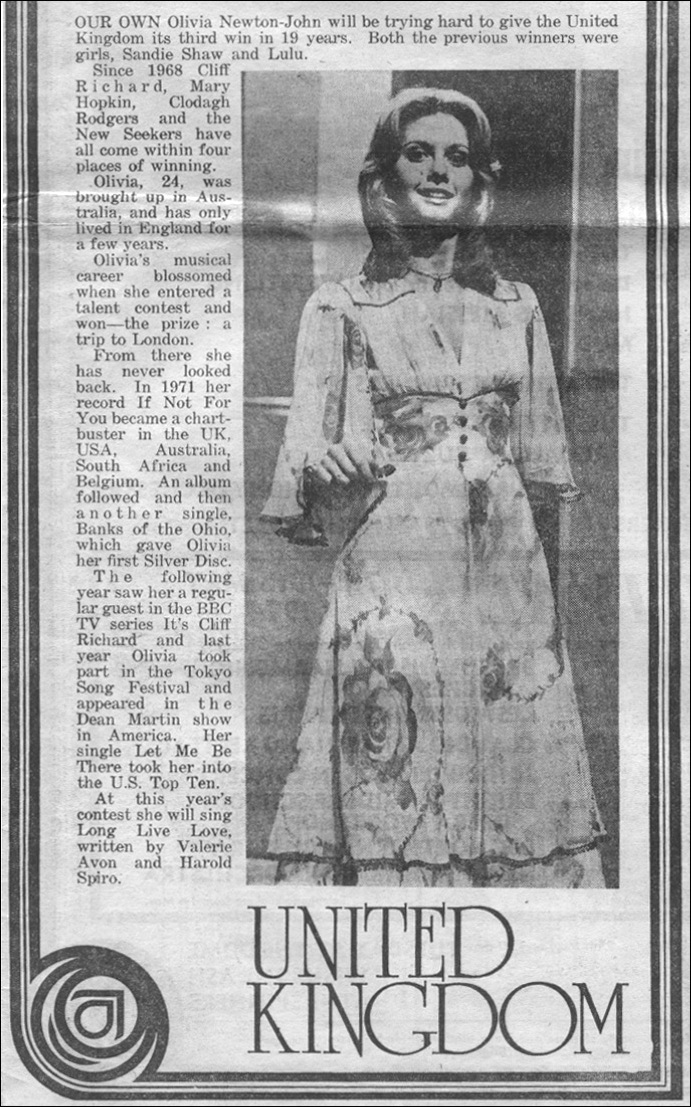
OUR OWN Olivia Newton-John will be trying hard to give the United Kingdom its third win in 19 years. Both the previous winners were girls, Sandie Shaw and Lulu.
Since 1968 Cliff Richard, Mary Hopkin, Clodagh Rodgers and the New Seekers have all come within four places of winning.
Olivia, 24, brought up in Australia, and has only lived in England for a few years. Olivia's musical career blossomed when she entered a talent contest and won the prize: a trip to London. From there she has never looked back. In 1971 her record If Not For You became a chart-buster in the UK, USA, Australia, South Africa and Belgium. An album followed and then another single. Banks of the Ohio, which gave Olivia her first Silver Disc.
The following year saw her a regular guest in the BBC TV series It's Cliff Richard and last year Olivia took part in the Tokyo Song Festival and appeared in the Dean Martin show in America. Her single Let Me Be There took her into the U.S. Top Ten.
At this year's contest she will sing Long Live Love, written by Valerie Avon and Harold Spiro.
Hanningtons wish Olivia Newton-John every success with Long live love
Long live love
and Olivia's latest LP Music makes my day
available now at HANNINGTONS RECORD DEPT., North Street, Brighton.