
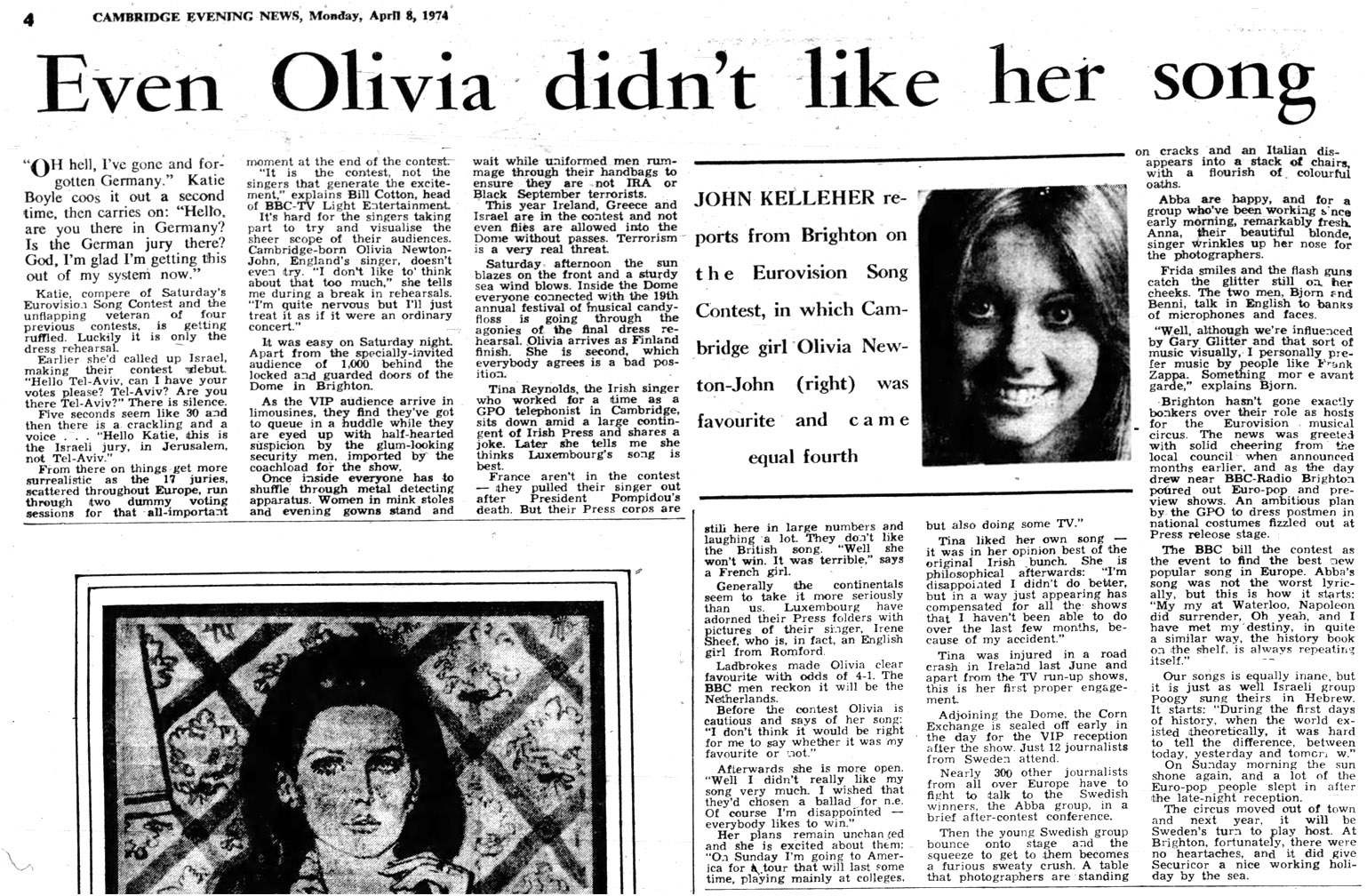
Even Olivia Didn't Like Her Song
Oh hell, I've gone and forgotten Germany.
Katie Boyle coos it out a second time, then carries on: Hello, are you there in Germany? Is the German jury there? God, I'm glad I'm getting this out of my system now.
Katie, of Saturday's Eurovision Song Content and the veteran of four unflapping previous contests, is getting ruffled. Luckily it is only the dress rehearsal.
Earlier she'd called up Israel. making their contest debut. Hello Tel-Aviv, can I have your votes please? Tel-Aviv? Are you there Tel-Aviv?
There is silence. Five seconds seem like 30 and then there is a crackling and a voice... Hello Katie, this is the Israeli jury, in Jerusalem, not Tel-Aviv.
From there on things get more surrealistic as the 17 juries, scattered throughout Europe, run through two dummy voting sessions for that all-important moment at the end of the contest
It's the contest, not the singers that generate the excitement, explains Bill Cotton, head of BBC-TV Light Entertainment.
It's hard for the singers taking part to try and visualise the sheer scope of their audiences. Cambridge-born Olivia Newton-John, England's singer, doesn't even try. I don't like to think about that too much,
she tells me during a break in rehearsals. I'm quite nervous but I'll just treat it as if it were an ordinary concert.
It was easy on Saturday night. Apart from the specially-invited audience of 1,000 behind the locked and guarded doors of the Dome in Brighton.
As the VIP audience arrive in limousines, they find they've got to queue in a huddle while they are eyed up with half-hearted suspicion by the glum-looking security men, imported by the coachload for the show.
Once inside everyone has to shuffle through metal detecting apparatus. Women in mink stoles and evening gowns stand and wait while uniformed men rummage through their handbags to ensure they are not IRA or Black September terrorists.
This year Ireland, Ireland, Greece and Israel are in the contest and not even flies are allowed into the Dome without passes. Terrorism is a very real threat.
Saturday afternoon the sun blazes on the front and a sturdy sea wind blows. Inside the Dome everyone connected with the 19th annual festival of musical candy-floss is going through the agonies of the final dress rehearsal. Olivia arrives as Finland finish. She is second, which everybody agrees is a bad position.
Tina Reynolds, the Irish singer who worked for a time as a GPO telephonist in Cambridge, sits down amid a large contingent of Irish Press and shares a joke. Later she tells me she thinks Luxembourg's song is best.
France aren't in the contest they pulled their singer out after President Pompidou's death. But their Press corps are still here in large numbers and laughing a lot. They don't like the British song. "Well she won't win. It was terrible," says a French girl.
The continentals generally seem to take it more seriously than us. Luxembourg have adorned their Press folders with pictures of their singer. Irene Sheef, who is, in fact, an English girl from Romford.
Ladbrokes made Olivia clear favourite with odds of 4-1. The BBC men reckon it will be the Netherlands. Before the contest Olivia is cautious and says of her song I don't think it would be right for me to say whether it was my favourite or not.
Afterwards she is more open, Well I didn't really like my song very much. I wished that they'd chosen a ballad for me. Of course I'm disappointed everybody likes to win
. Her plans remain unchanged and she is excited about them: On Sunday I'm going to America for a tour that will last some time, playing mainly at colleges but also doing some TV.
Tina liked her own song it was in her opinion best of the original Irish bunch. She is philosophical afterwards: I'm disappointed I didn't do better, but in a way just appearing has compensated for all the shows that I haven't been able to do over the last few months, because of my accident.
Tina was injured in a road crash in Ireland last June and apart from the TV run-up shows, this is her first proper engagement.
Adjoining the Dome. the Corn Exchange is sealed off early in the day for the VIP reception after the show. Just 12 journalists from Sweden attend. Nearly 300 other journalists from all over Europe have to fight to talk to the Swedish winners, the Abba group, in a brief after-contest conference.
Then the young Swedish group bounce onto stage and the squeeze to get to them becomes a furious sweaty crush. A table that photographers are standing on cracks and an Italian disappears into a stack of chairs, with a flourish of colourful oaths.
Abba are happy, and for a group who've been workings nee early morning, remarkably fresh. Anna, their beautiful blonde, singer wrinkles up her nose for the photographers. Frida smiles and the flash guns catch the glitter still on her cheeks. The two men. Bjorn and Benni, talk in English to banks of microphones and faces.
Well, although we're influenced by Gary Glitter and that sort of music visually, I personally prefer music by people like Frank Zappa Something more avant garde,
explains Bjorn.
Brighton hasn't gone exactly bonkers over their role as hosts for the Eurovision musical circus. The news was greeted with solid cheering from the local council when announced months earlier, and as the day drew near BBC Radio Brighton poured out Euro-pop and preview shows. An ambitious plan by the GPO to dress postmen in national costumes fizzled out at Press release stage.
The BBC bill the contest as the event to find the best new popular song in Europe. Abba's song was not the worst lyrically, but this is how it starts: My my at Waterloo, Napoleon did surrender, Oh yeah, and I have met my destiny, in quite a similar way, the history history book on the shelf, is always repeating itself.
Our songs is equally inane, but it is just as well Israeli group Poogy sung theirs in Hebrew. It starts: During the first days of history, when the world existed theoretically, it was hard to tell the difference, between today, yesterday and tomorrow.
On Sunday morning the sun shone again, and a lot of the Euro-pop people slept in after the late-night reception.
The circus moved out of town and next year. it will be Sweden's turn to play host. At Brighton, fortunately, there were no heartaches, and it did give Securicor a nice working holiday by the sea.
Sunday Sun newspaper, April 7 1974, UK
Olivia Slams Her Song
AN ANGRY and disappointed Olivia Newton-John said after last night's Eurovision song contest that she did not like the British song she sang Long Live Love.
Olivia attended a reception, given by the BBC and European Broadcasting Union for competitors and delegates after the contest, which was won by Sweden. She spoke in loud tones to a young man and looked disappointed and angry.
I would rather have sung a ballad,
she said. Her mother said: The British cannot pick songs.