
Women in Rock 1966-1975
70sthanks to Philippe
Click to enlarge
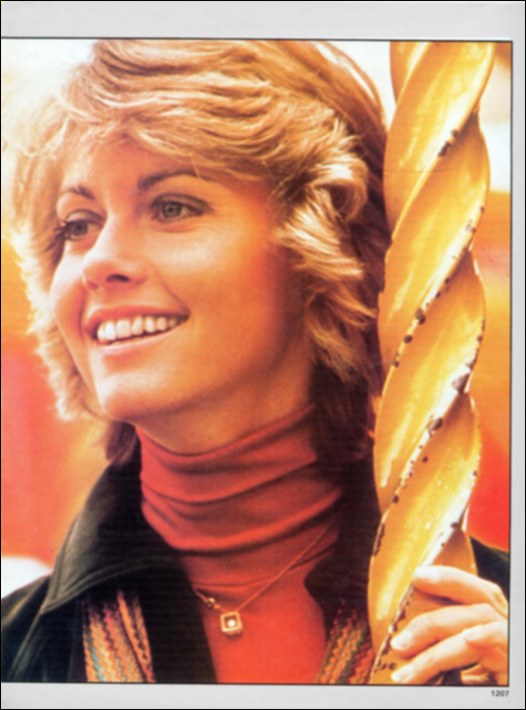
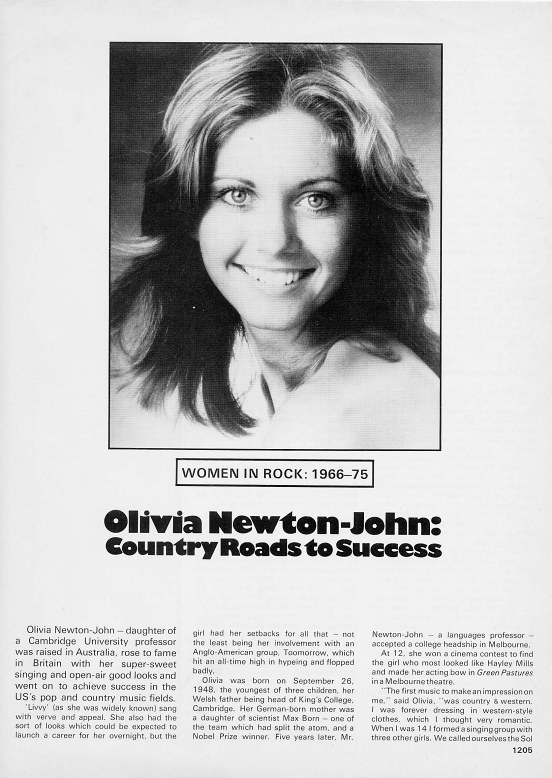
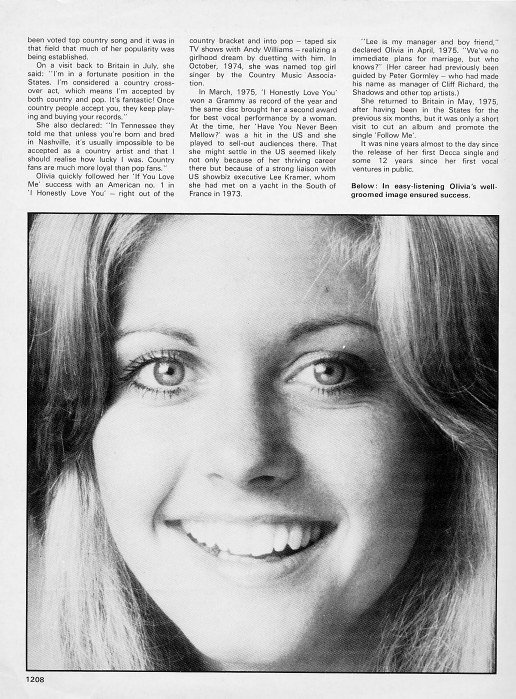
Olivia Newton-John-daughter of a Cambridge University professor was raised in Australia, rose to fame in Britain with her super-sweet singing and open-air good looks and went on to achieve success in the US's pop and country music fields.
Livvy as she was widely known) sang with verve and appeal. She also had the sort of looks which could be expected to launch a career for her overnight, but the girl had her setbacks for all that not the least being her involvement with an Anglo-American group, Toomorrow, which hit an all time high in hyping and flopped badly
Olivia was born on September 20 1948, the youngest of three children, her Welsh father being head of King's College, Cambridge. Her German-born mother was a daughter of scientist Mas Born one of the team which had split the atom, and a Nobel Prize winner. Five years later, Mr. Newton-John languages professor accepted a college headship in Melbourne.
At 12, she won a cinema contest to find the girl who most looked like Hayley Mills and made her acting bow in Green Pastures in a Melbourne theatre.
The first music to make an impression on me, said Olivia, was country and western. I was forever dressing in western-style clothes, which I thought very romantic. When I was 141 formed a singing group with three other girls. We called ourselves the Sol Four and wore jeans, hessian jackets and desert boots, then our parents decided our studies were suffering and we had to disband. But I acted in school plays and felt I would one day make a go of it in show business. The only other career which appealed to me was as a vet.
Having caught up with her studies, she gained experience as a solo singer in a local coffee bar it helped that the owner was married to her sister. Her first break came when she won a talent contest run by TV personality Johnny O'Keefe the prize being a round trip to Britain, but her parents insisted she complete her studies first.
My parents wanted me to go to university,
she recalled. My sister had opted out of this in favour of drama studies, and there was a bit of haggling when I said I also wanted to opt out and concentrate on singing, but my parents agreed when they realised how determined I was
.
Olivia travelled to London with her mother, auditioned successfully for Decca a few weeks later and they released hair first disc Till You Say You'll Be Mine (written by Jackie de Shannon) in May, 1966. Her spell with Decca was short and uneventful, and when Pat Carroll, who had been another up-and-coming girl singer in Australia, arrived in London, they teamed up
The Right Chemistry
As Pat and Olivia they played clubs, had spots on BBC TV and did a show at Bournemouth that triggered off a chain of events vital to Olivia's future. She found herself talking to a man fixing some sound gear backstage whom she thought was a roadie in fact he was Bruce Welch of the Shadows, who were doing a show there.
Though she and Bruce became friends, they parted company five weeks later, because Pat's work permit had lapsed, and Olivia went back to Australia with her. She was given her own TV series back home, but the following year she returned to Britain. Her friendship with Bruce Weilch resumed and a few months later they became engaged.
She was sidetracked however from her solo plans when asked to join Toomorrow, which was masterminded by James Bond film producer Harry Saltzman and Don Kirschner the disc producer who had created bubblegum groups the Monkees and the Archies, Toomorrow were to feature in a major movie and be launched on record and neither effort nor money was spared in an attempt to get the chemistry right.
Her partners in Toomorrow were Americans Ben Thomas and Kari Chambers and Britain's Vic Cooper, Toomorrow began work on their film late in 1969 and in 1970, the hyping started.
As the hand outs said Livvy has buttery skin, big, big, very round grey-green eyes: stands 5ft. 6ins and weighs 98 lbs. She dug they added Baez, horse riding Mac Davis, Redford. Bruce Welch. McQueen, Streisand, Feliciano, steak and salad, Hank Marvin, Beatles, wine Bacharach and her Red Setter named Geordie.
Despite the Kirschner Saltzman know how and being on the RCA label, Toomorrow's first disc. You're My Baby Now flopped badly. So too, despite all the lavish and dogged hyping, did the film and their further chart bids, and soon after Toomorrow had finally become yesterday. Olivia reverted to a solo career.
Through Bruce Welch, she had become friendly with the other Shadows (whose John Farrar had married Pat Carroll) and Cliff Richard. Recognizing her promise, he duetted with her on the side of one of his discs the first time he'd let a girl do that.
He also featured her in his TV series and booked her for his Continental tour in the spring of 1971.
But even before the tour had begun, she had made it as a solo disc performer. Her first release on the Pye-released Festival label was Dylan's If Not For You, and despite competition from the great man himself, she beat him in the British charts. Her disc also scored in the US.
Though her next disc flopped, she out her fest solo album with Bruce Welch and John Farrar as producers, and included Banks Of The Ohio - a Joan Baez favourite she had loved years before, which late in 1971 as a single sold over a quarter of a million.
Earlier that year she had topped a music paper poll, she repeated the feat early in 1972 and had another hit with What Is Life? That April her personal life made headlines when she and Bruce Welch ended their engagement and three days later he was rushed to hospital reportedly because of a drugs overdose.
Her career continued to flourish in Britain and she scored another hit early in 1973 with Take Me Home, Country Roads. In Britain that summer she flopped with Let Me Be There by the late John Rostill of the Shadows, but the disc brought her her first Top Ten hit in the States and later won a Grammy award.
Top Country Song
She was performing in Australia in November when she had a phone call asking her to sing for Britain in the prestigious 1974 Eurovision Contest. Britain's song for the contest (held at Brighton, Sussex, in April 1974) was Long Live Love by Valerie Avon and Harold Spiro which came third, and Olivia was later quoted as saying she hadn't thought the song (picked by a viewers' vote) right for the event. But her record of it was a hit. Shortly after, how ever she switched to EMI Records.
She went to the US for college dates and other gigs which included appearing at Disneyland and on the Johnny Carson Show. Her visit boosted her disc sales powerfully and If You Love Me, Let Me Know became a Stateside hit. Her previous US hit Let Me Be There had been voted top country song and it was in that field that much of her popularity wee being established.
On a visit back to Britain in July, she said: I'm in a fortunate position in the States. I'm considered a country cross-over act, which means I'm accepted by both country and pop. It's fantastic! Once country people accept you, they keep playing and buying your records
.
She also declared In Tennessee they told me that unless you're born and bred in Nashville, it's usually impossible to be accepted as a country artist and that I should realise how lucky was. Country fans are much more loyal than pop fans.
Olivia quickly followed her If You Love Me
success with an American no. 1 in I Honestly Love You, right out of the country bracket and into pop. taped six TV shows with Andy Williams - realizing a girlhood dream by duetting with him. In October, 1974, she was named top girl singer by the Country Music Association.
In March, 1975, I Honestly Love You won a Grammy as record of the year and the same disc brought her a second award for best vocal performance by a woman, At the time, her Have You Never Been. Mellow? was a hit in the US and she played to sell-out audiences there. That she might settle in the US seemed likely not only because of her thriving career there but because of a strong liaison with US showbiz executive Lee Kramer, whom she had met on a yacht in the South of France in 1973.
Lee my manager and boy friend
declared Olivia in April 1975. We've no immediate plans for marriage, but who knows?
Her career had previously been guided by Peter Gormley who had made his name as manager of Cliff Richard, the Shadows and other top artists.)
She returned to Britain in May, 1975 after having been in the States for the previous six months, but it was only a short visit to cut an album and promote the single Follow Me
It was nine years almost to the day since the release of her first Decca single and some 12 years since her first vocal ventures in public.