
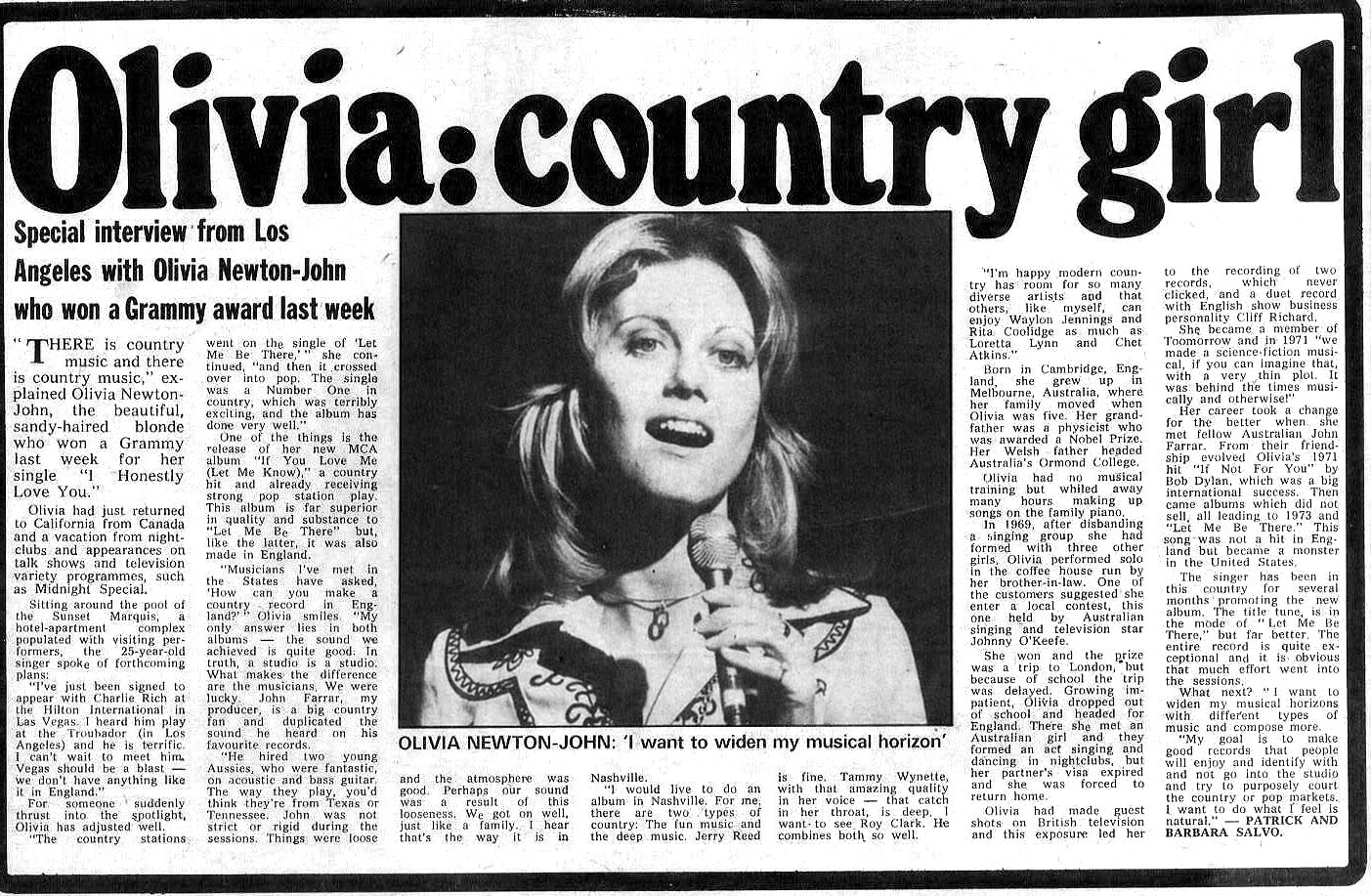
Olivia - Country Girl
“THERE is country music and there is country music,” explained Olivia Newton-John, the beautiful, sandy-haired blonde who won a Grammy last week for her single “I Honestly Love You.”
Olivia had just returned to California from Canada and a vacation from night-clubs and appearances on talk shows and television variety programmes, such as Midnight Special.
Sitting around the pool of a complex the Sunset Marquis, hotel-apartment populated with visiting performers, the 25-year-old singer spoke of forthcoming plans: “I’ve just been signed to appear with Charlie Rich at the Hilton International in Las Vegas. I heard him play at the Troubador Angeles and he is terrific. I can’t wait to meet him, Vegas should be a blast we don’t have anything like it in England.”
For someone suddenly thrust into the spotlight, Olivia has adjusted well.
“The country stations went on the single of ‘Let Me Be There, she continued, “and then it crossed over into pop. The single was Number One in country, which was terribly exciting, and the album has done very well.”
One of the things is the release of her new MCA album “If You Love Me (Let Me Know),” a country hit and already receiving strong pop station play This album is far superior in quality and substance to “Let Me Be There” but, like the latter, it was also made in England.
“Musicians I’ve met in the States have asked, How can you make a country record in England? Olivia smiles “My only answer lies in both albums the sound we achieved is quite good. In truth, a studio is a studio. What makes the difference are the musicians. We were lucky John Farrar, my producer, is a big country fan and duplicated the sound he heard on favourite records his.”
“He hired two young Aussies, who were fantastic, on acoustic and bass guitar. The way they play, you’d think they’re they’re from from Texas or Tennessee, John was not strict or rigid during the sessions. Things were loose and the atmosphere was good. Perhaps our sound result of this looseness. We got on well, Just like a family. I hear that’s the way it is in Nashville.”
“I would like to do an album in Nashville. For me, there are two types of country: The fun music and the deep music. Jerry Reed is fine. Tammy Wynette, with that amazing quality in her voice that catch in her throat, is deep. I want to see Roy Clark. He combines both so well.”
“I’m happy modern country has room for so many diverse artists and that others like can enjoy Waylon Jennings and Rita Coolidge as much Loretta Lynn and Chet Atkins.”
Born in Cambridge, England, she grew up in Melbourne, Australia, where her family moved when Olivia was five. Her grandfather was physicist who was awarded a Nobel Prize. Her Welsh father headed Australia’s Ormond College. Olivia had no musical training but whiled away many hours making up songs on the family piano.
In 1969, after disbanding a singing group she had formed with three other giris, Olivia performed solo in the coffee house run by her brother-in-law. One of the customers suggested she enter a local contest, this held by Australian singing and television star Johnny O’Keefe.
She won and the prize was a trip to London, but because of school the trip was delayed. Growing impatient, Olivia dropped out of school and headed for England. There she met an Australian girl and they formed an act singing and dancing in nightclubs, but her partner’s visa expired and she was forced to return home.
Olivia had made guest shots on British television and this exposure led her to the recording of two records, which never clicked, and a duet record with English show business personality Cliff Richard.
She became a member of Toomorrow and in 1971 “we made a science-fiction science musical, if you can imagine that, with a very thin plot. It was behind the times musically and otherwise!”
Her career took a change for the better when she met fellow Australian John Farrar. From their friendship evolved Olivia’s 1971 hit “If Not For or You” by Bob Dylan, which was a big international success. Then came albums which did not sell, all leading to 1973 and “Let Me Be There.” This song was not a hit in England but became a monster in the United States.
The singer has been in this country for several months promoting the new album. The title tune, is in the mode of “Let Me Be There,” but for better. The entire record is quite eceptional and it is obvious that much effort went into the sessions.
What next? I want to widen my musical horizons with different types of music and compose more
“My goal is to make good records that people will enjoy and identify with and not go into the studio and try to purposely court the country or pop markets. I want to do what feel is natural.”
By Patrick and Barbara Salvo.