
Cease Fire in Nashville
By LaWayne Satterfield
Olivia Newton-John has made peace overtures to end a fuss that began when critics said an Australian pop singer had no right to claim the title of American country-music queen.
The row started two years ago when Olivia won the 1974 Country Music Association Female Vocalist of the Year award.
“But all this is in the past and doesn’t worry me anymore,” Olivia told Rambler, when she arrived in Nashville to record for the first time in Music City. “I think I was the person they used as a scapegoat at the time.”
“In fact, Dolly Parton told me recently that the press blew the whole thing out of proportion…that it wasn’t anything like it seemed to be.”
At the time, Johnny Paycheck had been one of Olivia’s most outspoken critics. “We don’t want somebody out of another field coming in and taking away what we’ve worked so hard for,” he said.
Among others, Paycheck felt that Dolly deserved the award.
Most foes considered Olivia an outsider on two counts. First, they felt her music fitted the pop category better than it did country. Second, they considered her an outsider because she was born in Britain and grew up in Australia far away from what many Americans might consider a “country” background.
Olivia might not have been born into a county tradition, but it is one that she is most comfortable with.
Max Born, her grandfather, was a Nobel Prize-winning physicist and Albert Einstein’s closest friend. Her father, a Welshman, gave up an opera career to become a college professor and dean.
“He had a collection of a thousand records, mostly classical,” Olivia said. “But he gave me Tennessee Ernie Ford records, too.”
“My other musical influences while growing up were Ray Charles, Joan Baez and Nina Simone, so you can see I was exposed to all forms of music - everything from classical to country, blues and folk to jazz.”
The family moved to Australia when Olivia was five. She started to sing in her teens “just for something to do.” With three friends, she formed a group, The Sol Four. It broke up when practice time began to interfere with schooling.
Despite the setback, Olivia was determined to be a singer. She quit school to begin a solo career in a Melbourne coffee house owned by her brother-in-law.
At 16, she entered and won a talent contest. The top prize was a trip to Britain. She returned to her former homeland and formed a duet with Pat Carroll, another young Australian. But when the other girl’s visa expired and she was forced to return Down Under, Olivia stayed on, became a BBC-TV regular and recorded her first single, If Not For You. A Bob Dylan song, it earned her acclaim. around the world.
More recently, however, it’s been songs like I Honestly Love You, Have You Never Been Mellow and Let Me There that have climbed high in the American country charts and have had pop fans comparing her to Barbra Streisand.
Nevertheless, tension still weighed heavily upon the air in Nashville when she arrived at MCA Records headquarters for a press conference and to cut her new album.
The press, at least, still remembered the wrong of two years ago.
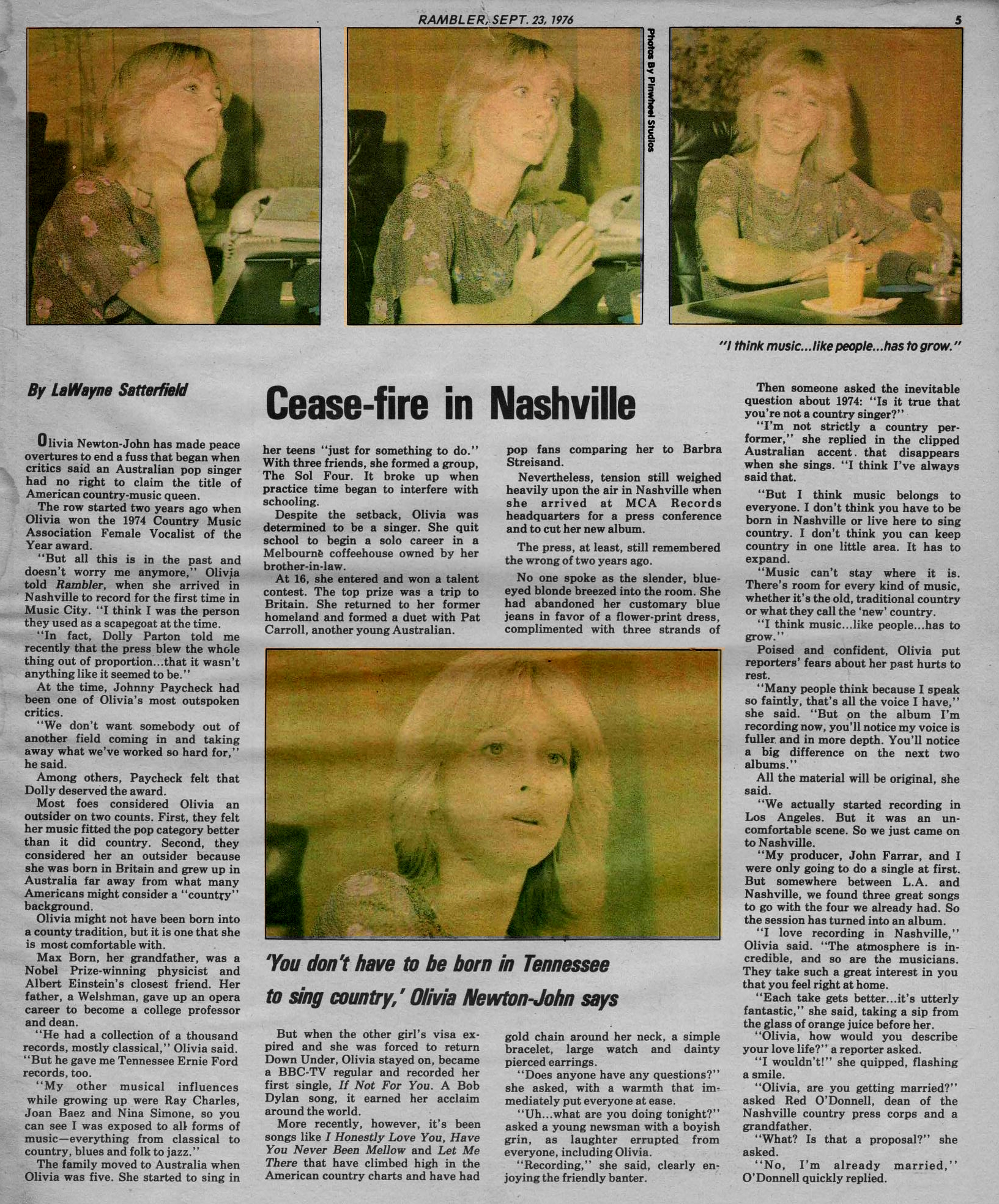
No one spoke as the slender, blue-eyed blonde breezed into the room. She had abandoned her customary blue jeans in favor of a flower-print dress, complimented with three strands of gold chain around her neck, a simple bracelet, large watch and dainty pierced earrings.
“Does anyone have any questions?” she asked, with a warmth that immediately put everyone at ease.
“Uh…what are you doing tonight?” asked a young newsman with a boyish grin, as laughter errupted from everyone, including Olivia.
“Recording,” she said, clearly enjoying the friendly banter.
Then someone asked the inevitable question about 1974: “Is it true that you’re not a country singer?”
“I’m not strictly a country performer,” she replied in the clipped Australian accent, that disappears when she sings. “I think I’ve always said that.”
“But I think music belongs to everyone. I don’t think you have to be born in Nashville or live here to sing country. I don’t think you can keep country in one little area. It has to expand.”
“Music can’t stay where it is. There’s room for every kind of music, whether it’s the old, traditional country or what they call the ‘new’ country.”
“I think music…like people…has to grow.”
Poised and confident, Olivia put reporters’ fears about her past hurts to rest.
“Many people think because I speak so faintly, that’s all the voice I have”, she said. “But on the album I’m recording now, you’ll notice my voice is fuller and in more depth. You’ll notice a big difference on the next two albums.”
All the material will be original, she said.
“We actually started recording in Los Angeles. But it was an uncomfortable scene. So we just came on to Nashville”.
“My producer, John Farrar, and I were only going to do a single at first. But somewhere between L.A. and Nashville, we found three great songs to go with the four we already had. So the session has turned into an album.
“I love recording in Nashville,” Olivia said. “The atmosphere is incredible, and so are the musicians. They take such a great interest in you that you feel right at home.”
“Each take gets better…it’s utterly fantastic,” she said, taking a sip from the glass of orange juice before her.
“Olivia, how would you describe your love life?” a reporter asked.
“I wouldn’t!” she quipped, flashing a smile.
“Olivia, are you getting married?” asked Red O’Donnell, dean of the Nashville country press corps and a grandfather.
“What? Is that a proposal?” she asked.
“No. I’m already married,” O’Donnell quickly replied.