
Today's girl singers
THEY used to be called “girl singers” and generally married the best player in the band. In the ’40s and ’50s the movies made them major stars. With the ’60s they all grew their hair and learned to play guitar.
Female vocalists have always been with us, but rarely in such prominent display as today. In recent weeks many of the top spots on the pop charts have been filled by women.
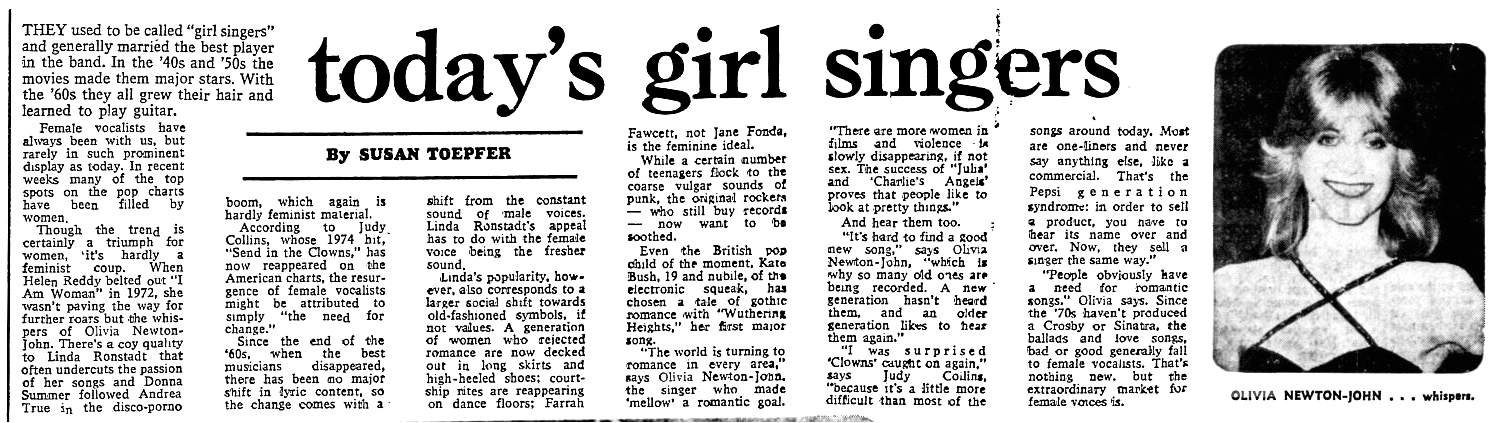
Though the trend is certainly a triumph for women, it’s hardly a feminist coup. When Helen Reddy belted out “I Am Woman” in 1972, she wasn’t paving the way for further roars but the whispers of Olivia Newton-John.
There’s a coy quality to Linda Ronstadt that often undercuts the passion of her songs and Donna Summer followed Andrea True in the disco-poraoboom, which again is hardly feminist material.
According to Judy Collins, whose 1974 hit, “Send in the Clowns,” has now reappeared on the American charts, the resurgence of female vocalists might be attributed to simply “the need for change.”
Since the end of the ’60s, when the best musicians disappeared, there has been no major shift in lyric content, so the change comes with a shift from the constant sound of male voices. Linda Ronstadt’s appeal has to do with the female voice being the fresher sound.
Linda’s popularity, however, also corresponds to a larger social shift towards old-fashioned symbols, if not values. A generation of women who rejected romance are now decked out in long skirts and high-heeled shoes; courtship rites are reappearing on dance floors: Farrah Fawcett, not Jane Fonda, is the feminine ideal.
While a certain number of teenagers flock to the coarse vulgar sounds of punk, the original rockers who still buy records want to be soothed.
Even the British pop girl of the moment, Kate Bush, 19 and nubile, of the electronic squeak, has chosen a tale of gothic romance with “Wuthering Heights,” her first major song.
“The world is turning to romance in every area,” says Olivia Newton-JoHn. the singer who made “mellow” a romantic goal.
“There are more women in films and violence is slowly disappearing, if not sex. The success of “Julia” and ‘Charlie’s Angeis” proves that people like to look at pretty things.”
And hear them too.
“It’s hard to find a good new song,” says Olivia Newton-John, “which is why so many old ones are beung recorded. A new generation hasn’t heard them, and an older generation likes to hear them again.”</strong>
“I was surprised “Clowns’ caught on again,” says Judy Collins, “because it’s a little more difficult than most of the songs around today. Most are one-liners and never say anything else, like a commercial. That’s the Pepsi generation syndrome: in order to sell a product, you have to hear its name over and over. Now, they sell a singer the same way.”
“People obviously have a need for romantic songs.” Olivia says.
Since the 70s haven’t produced a Crosby or Sinatra, the ballads and love songs, bad or good generally fall to female vocalists. That’s nothing new, but the extraordinary market for female voices is.