
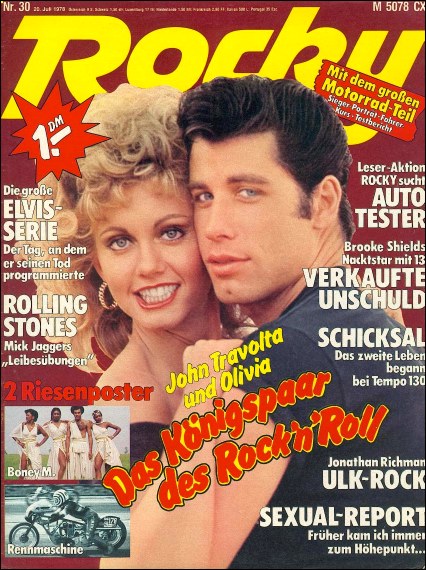
John Travolta and Olivia - king and queen of rock'n'roll
70sthanks to Philippe Roumila
Click to enlarge
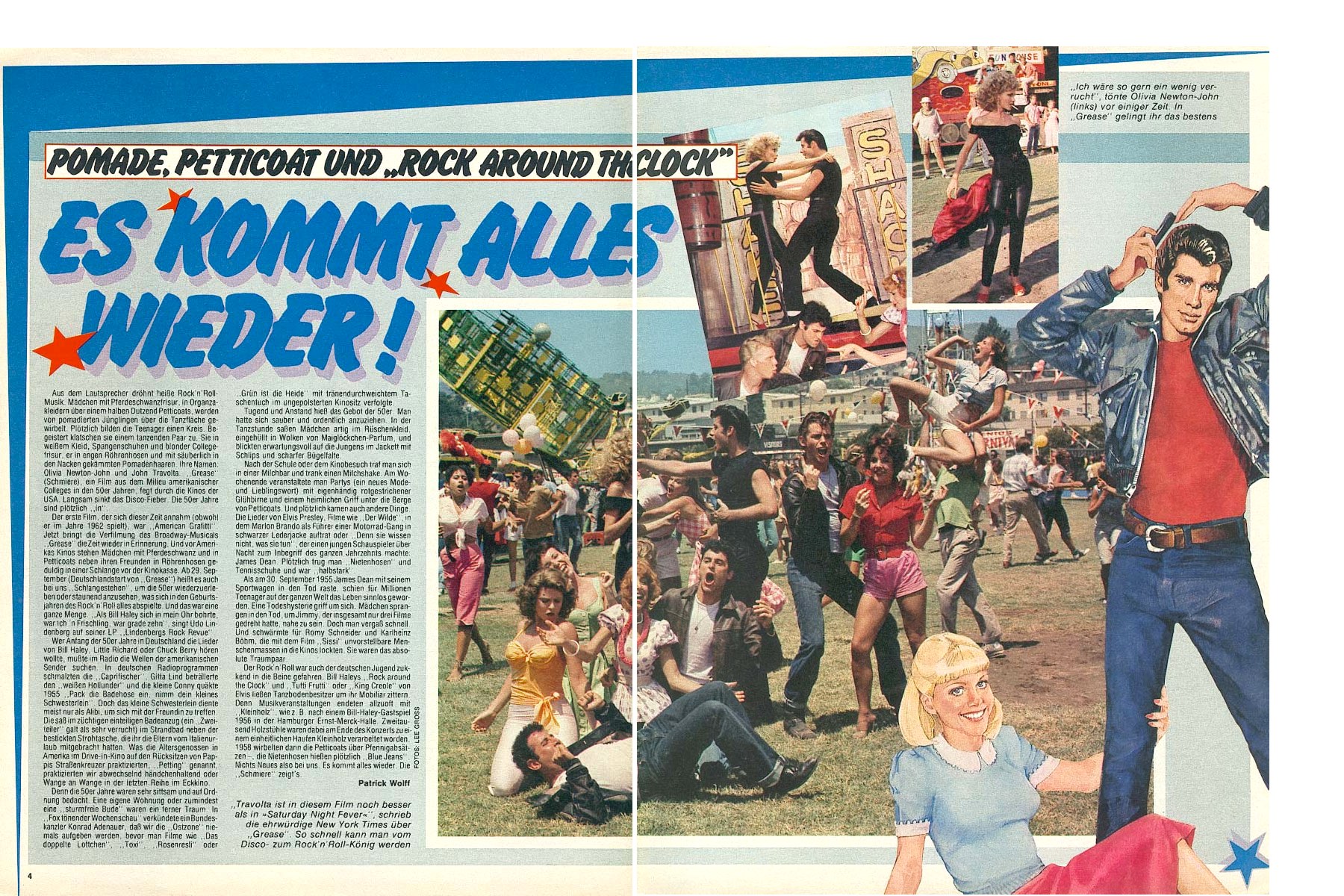
Translation:
Hot rock 'n' roll music booms from the loudspeakers. Girls with ponytails, wearing dresses over half a dozen petticoats, are whirled across the dance floor by youths. Suddenly, the teenagers form a circle. They applaud enthusiastically for a dancing couple. She in a white dress, high heels, and a blond college hairstyle, he in tight skinny jeans and his hair neatly combed back at the nape of his neck. Their names: Olivia Newton-John and John Travolta.
Grease, a film set in the American college of the 1950s, is sweeping through cinemas across the US. Disco fever is slowly subsiding. The 50s are suddenly back.
The first film to address this era (although it was set in 1962) was American Graffiti. Now the film adaptation of the Broadway musical Grease brings that era back to life. And in front of American cinemas, girls with ponytails and in petticoats stand patiently in line at the box office next to their boyfriends in skinny jeans.
From September 29th (German release of Grease), we too will be queuing up to relive the 50s or to marvel at everything that happened in the birth years of rock 'n' roll. And that was a lot. When Bill Haley pierced my ear, I was a freshman, just ten,
sings Udo Lindenberg on his LP Lindenbergs Rock Revue.
Anyone in Germany in the early 1950s who wanted to hear the songs of Bill Haley, Little Richard, or Chuck Berry had to search for American radio stations. On German radio programs, the Caprifischer crooned. Gitta Lind crooned about the white elderberry, and little Conny squawked in 1955.
Pack your swimming trunks, take your little sister. But the little sister mostly served only as an alibi to meet up with her girlfriend. She sat in a modest one-piece swimsuit (one, two-piece was considered very wicked) at the lido next to the embroidered straw bag that her parents had brought her from their Italian vacation. What her contemporaries in America practiced in the backseats of their dad's road cruiser at the drive-in cinema, called petting, We practiced taking turns holding hands or cheek to cheek in the last row of the corner cinema.
The 1950s were very modest and conscious of order. An apartment of our own or at least a shelter-skelter
was a distant dream. In a Fox-sounding newsreel, Chancellor Konrad Adenauer announced that we would never give up the Eastern Zone before films like The Double Lottie,
Toxi Rosenresli,
or The heath is green
, with a tear-soaked handkerchief in an unpadded cinema seat, pursued virtue and decency were the commandments of the 50s.
You had to dress neatly and tidily. In dance class, girls sat politely in frilly dresses, enveloped in clouds of lily of the valley perfume, and looked expectantly at the boys in jackets, ties and sharp creases. After school or a trip to the cinema, people met in a milk bar and drank a milkshake. At the weekend, parties were thrown (a new fashionable and favorite word) with lightbulbs painted red by hand and a secret grope under the mountains of petticoats.
And suddenly, other things came along, too. The songs of Elvis Presley. Films like... The Wild One
, in which Marlon Brando appeared as the leader of a motorcycle gang in a black leather jacket, or Cause They Don't Know What They're Doing,
which made a young actor the epitome of the entire decade overnight: James Dean. Suddenly, people were wearing studded trousers and tennis shoes and were teenagers.
When James Dean crashed his sports car to his death on September 30, 1955, life seemed meaningless for millions of teenagers around the world. A death hysteria took hold. Girls jumped to their deaths to be close to Jimmy, who had only made three films. But people quickly forgot and raved about Romy Schneider and Karlheinz Böhm, who attracted unimaginable crowds to the cinemas with the film Sissi. They were the absolute dream couple.
Rock 'n' roll had also taken hold of German youth. Bill Haley's Rock around the Clock
and Tutti Frutti
or Elvis' King Creole
made dance floor owners tremble for their furniture. Because music events all too often ended in fire, as for example after a Bill Haley guest appearance in 1956 in the Hamburg Ernst Merck Hall. Two thousand wooden chairs were turned into a uniform pile of kindling at the end of the concert.
In 1958, petticoats swirled over stiletto heels, and studded trousers were suddenly called blue jeans.
Nothing new for us, then. Everything comes back. The greasepaint shows it.
By Patrick Wolff
Photo caption: Travolta is even better in this film than in Saturday Night Fever,
wrote the venerable New York Times about Grease. That's how quickly you can go from disco to rock 'n' roll king.