
Grease
70sthanks to Kay
Click to enlarge
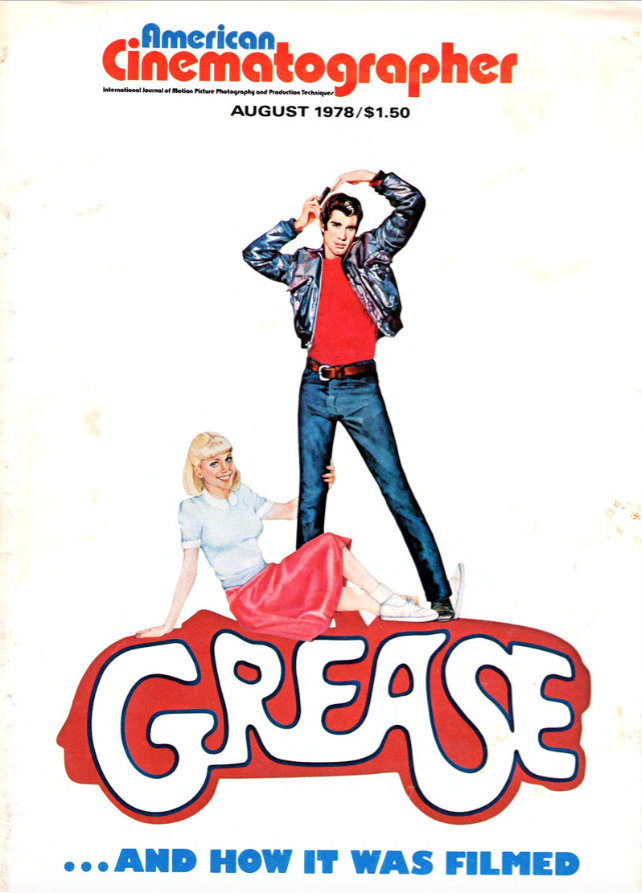
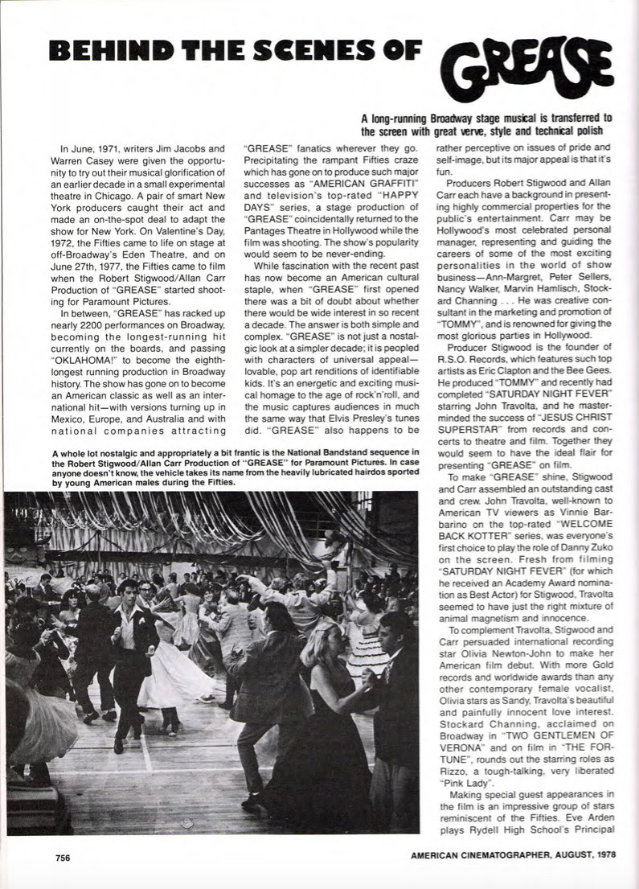
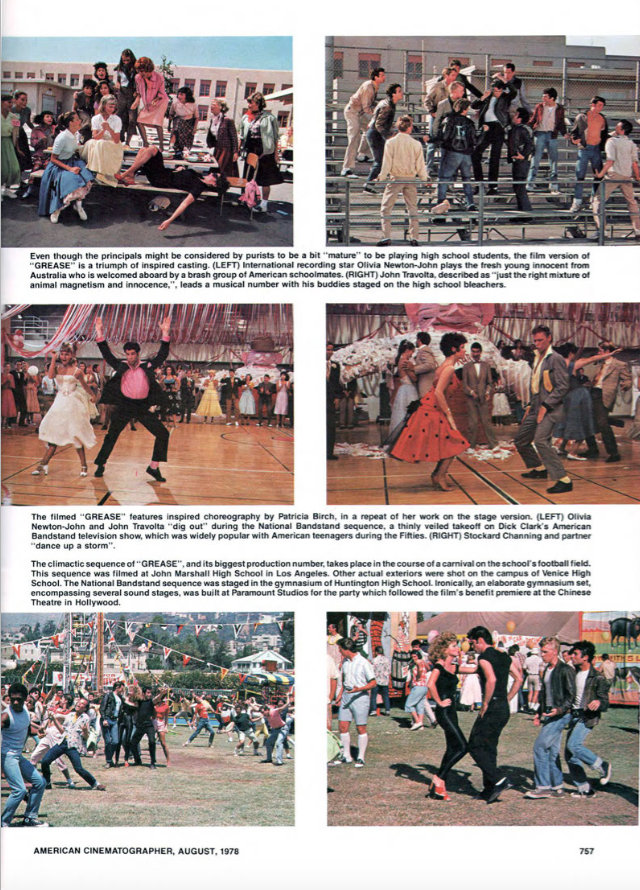
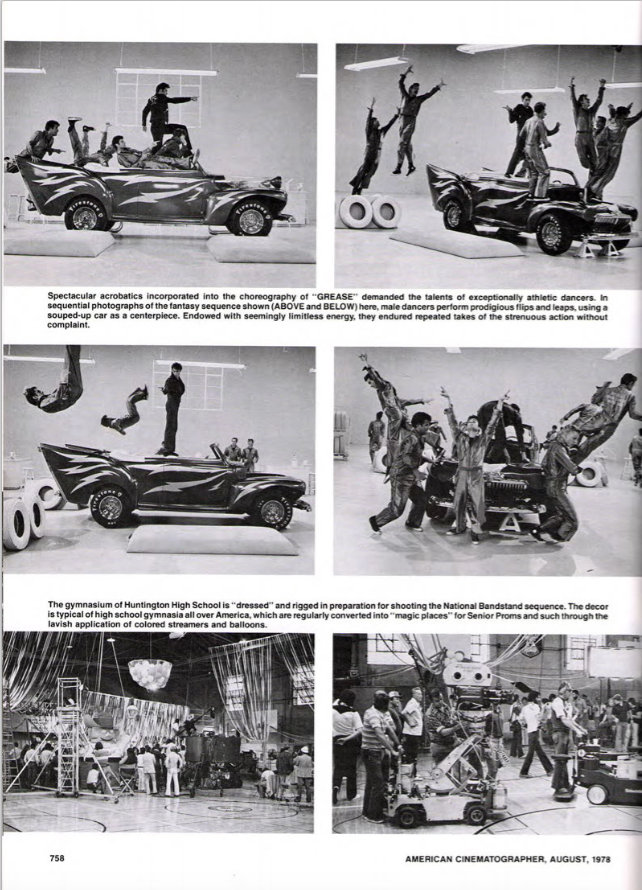
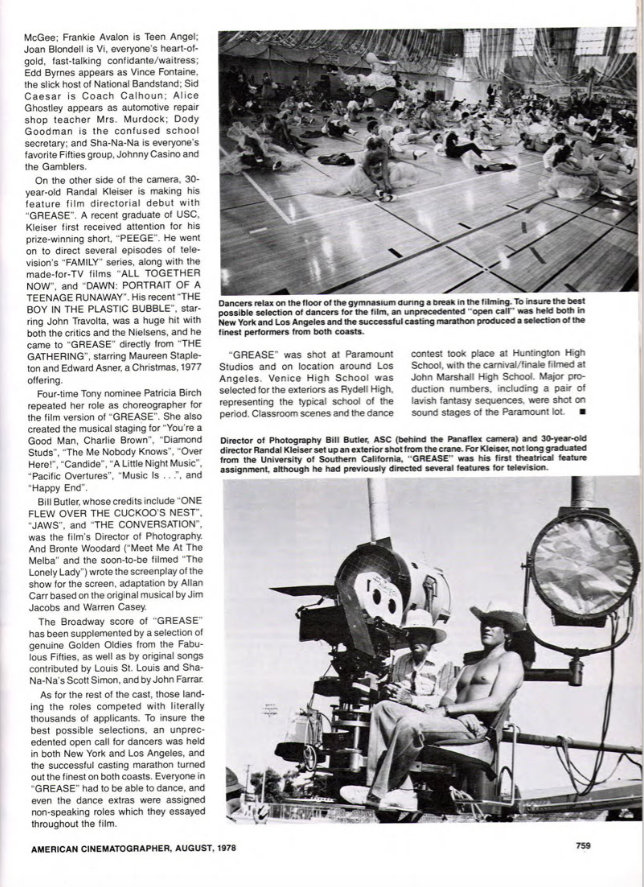
A whole lot nostalgic and appropriately a bit frantic is the National Bandstand sequence in the Robert Stigwood/Allan Carr Production of GREASE for Paramount Pictures. In case anyone doesn't know, the vehicle takes its name from the heavily lubricated hairdos sported by young American males during the Fifties.
In June, 1971, writers Jim Jacobs and Warren Casey were given the opportunity to try out their musical glorification of an earlier decade in a small experimental theatre in Chicago.
A pair of smart New York producers caught their act and made an on-the-spot deal to adapt the show for New York. On Valentine's Day, 1972, the Fifties came to life on stage at off-Broadway's Eden Theatre, and on June 27th, 1977, the Fifties came to film when the Robert Stigwood/Allan Carr Production of GREASE
started shooting for Paramount Pictures.
In between, GREASE
has racked up nearly 2200 performances on Broadway. becoming the longest-running hit currently on the boards, and passing OKLAHOMA to become the eighth longest running production in Broadway history The show has gone on to become an American classic as well as an international hit - with versions turning up in Mexico, Europe, and Australia and with national companies attracting GREASE
fanatics wherever they go
Precipitating the rampant Fifties craze which has gone on to produce such major successes as AMERICAN GRAFFITI and television's top-rated HAPPY DAYS series, a stage production of GREASE
coincidentally returned to the Pantages Theatre in Hollywood while the film was shooting. The show's popularity would seem to be never-ending.
While fascination with the recent past has now become an American cultural staple, when GREASE
first opened there was a bit of doubt about whether there would be wide interest in so recent a decade. The answer is both simple and complex.
GREASE
is not just a nostalgic look at a simpler decade; it is peopled with characters of universal appeal - lovable, pop art renditions of identifiable kids. It's an energetic and exciting musical homage to the age of rock'n'roll, and the music captures audiences in much the same way that Elvis Presley's tunes did.
GREASE
also happens to be rather perceptive on issues of pride and self-image, but its major appeal is that it's fun.
Producers Robert Stigwood and Allan Carr each have a background in presenting highly commercial properties for the public's entertainment. Carr may be Hollywood's most celebrated personal manager, representing and guiding the careers of some of the most exciting personalities in the world of show business - Ann-Margret, Peter Sellers, Nancy Walker, Marvin Hamlisch, Stockard Channing. He was creative consultant in the marketing and promotion of TOMMY, and is renowned for giving the most glorious parties in Hollywood.
Producer Stigwood is the founder of R.S.O. Records, which features such top artists as Eric Clapton and the Bee Gees Hie produced TOMMY and recently had completed SATURDAY NIGHT FEVER starring John Travolta, and he master minded the success of JESUS CHRIST SUPERSTAR from records and concerts to theatre and film. Together they would seem to have the ideal flair for presenting GREASE
on film.
To make GREASE
shine, Stigwood and Carr assembled an outstanding cast and crew John Travolta, well-known to American TV viewers as Vinnie Barbarino on the top-rated WELCOME BACK KOTTER series, was everyone's first choice to play the role of Danny Zuko on the screen. Fresh from filming SATURDAY NIGHT FEVER (for which he received an Academy Award nomination as Best Actor) for Stigwood, Travolta seemed to have just the right mixture of animal magnetism and innocence.
To complement Travolta, Stigwood and Carr persuaded international recording star Olivia Newton-John to make her American film debut. With more Gold records and worldwide awards than any other contemporary female vocalist. Olivia stars as Sandy, Travolta's beautiful and painfully innocent love interest.
Stockard Channing, acclaimed on Broadway in TWO GENTLEMEN OF VERONA and on film in THE FOR TUNE, rounds out the starring roles as Rizzo, a tough-talking, very liberated Pink Lady
.
Making special guest appearances in the film is an impressive group of stars reminiscent of the Fifties. Eve Arden plays Rydell High School's Principal McGee: Frankie Avalon is Teen Angel: Joan Blondell is Vi, everyone's heart-of-gold, fast-talking confidante/waitress; Edd Byrnes appears as Vince Fontaine, the slick host of National Bandstand, Sid Caesar is Coach Calhoun: Alice Ghostley appears as automotive repair shop teacher Mrs. Murdock; Dody Goodman is the confused school secretary; and Sha-Na-Na is everyone's favorite Fifties group, Johnny Casino and the Gamblers.
On the other side of the camera, 30-year-old Randal Kleiser is making his feature film directorial debut with GREASE
. A recent graduate of USC, Kleiser first received attention for his prize-winning short, PEEGE. He went on to direct several episodes of television's FAMILY series, along with the made-for-TV films ALL TOGETHER NOW, and DAWN: PORTRAIT OF A TEENAGE RUNAWAY. His recent THE BOY IN THE PLASTIC BUBBLE, starring John Travolta, was a huge hit with both the critics and the Nielsens, and he came to GREASE directly from THE GATHERING, starring Maureen Stapleton and Edward Asner, a Christmas, 1977 offering.
Four-time Tony nominee Patricia Birch repeated her role as choreographer for the film version of GREASE
. She also created the musical staging for You're a Good Man, Charlie Brown, Diamond Studs, The Me Nobody Knows, Over Here!, Candide, A Little Night Music, Pacific Overtures, Music Is..., and Happy End.
Bill Butler, whose credits include ONE FLEW OVER THE CUCKOO'S NEST, JAWS, and THE CONVERSATION, was the film's Director of Photography. And Bronte Woodard (Meet Me At The Melba and the soon-to-be filmed The Lonely Lady) wrote the screenplay of the show for the screen, adaptation by Allan Carr based on the original musical by Jim Jacobs and Warren Casey.
The Broadway score of GREASE
has been supplemented by a selection of genuine Golden Oldies from the Fabulous Fifties, as well as by original songs contributed by Louis St. Louis and Sha Na-Na's Scott Simon, and by John Farrar.
As for the rest of the cast, those landing the roles competed with literally thousands of applicants. To insure the best possible selections, an unprecedented open call for dancers was held in both New York and Los Angeles, and the successful casting marathon turned out the finest on both coasts. Everyone in GREASE
had to be able to dance, and even the dance extras were assigned non-speaking roles which they essayed throughout the film.
GREASE was shot at Paramount Studios and on location around Los Angeles. Venice High School was selected for the exteriors as Rydell High, representing the typical school of the period.
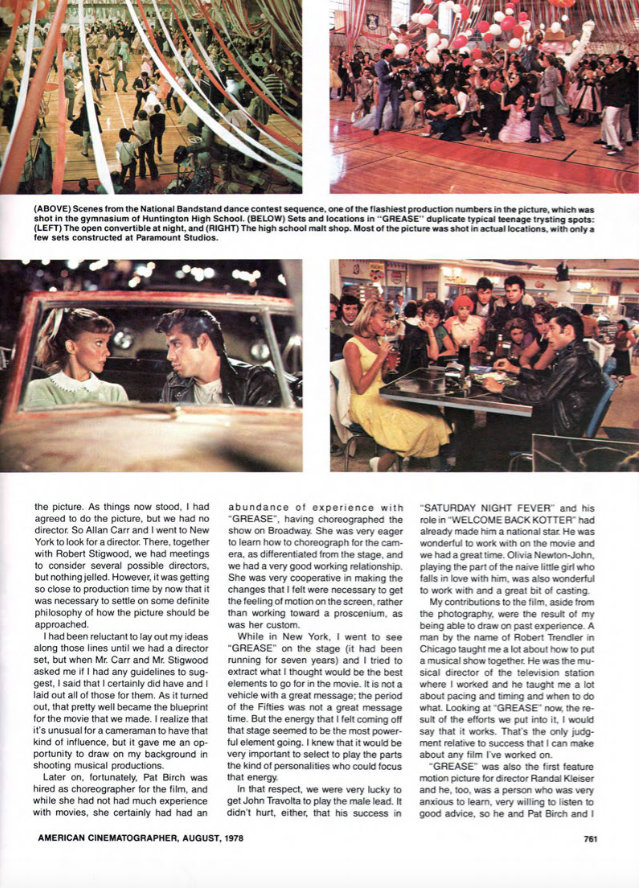
Classroom scenes and the dance contest took place at Huntington High School, with the carnival/finale filmed at John Marshall High School. Major production numbers, including a pair of lavish fantasy sequences, were shot on sound stages of the Paramount lot.
PHOTOGRAPHING GREASE
By Bill Butler, ASC, Director of Photography
The particular challenge of photographing a musical film like GREASE
is that it involves elements that you don't encounter in a show of a different kind. In musicals - especially a musical of this type - you have to consider the motion of the camera, as well as the motion of the dancing. You have to decide how best to show the dancing, because a close-up of someone's face when that person is dancing doesn't show the audience much of the body movement. I don't know of any musical which does not involve seeing the entire person. To put across the story line, while photographing the musical numbers properly, is really the challenge.
Allan Carr asked me to photograph GREASE
when I was shooting CAPRICORN ONE and, although I admired his flair for this kind of show, I wanted to wait to see who the director would be before I agreed to do it. Allan Carr is certainly the right producer for this kind of picture because he understands the musical format and I think he's a little bit in love with the old Hollywood style of doing such films. I thought that it might be exciting to tackle a musical with him. At the same moment, I realized that there are a lot of traps in making musicals and that you can go wrong very easily. Musicals have lost favor with the public, mainly because they have been done poorly. You have to avoid giving them something that is poorly constructed, poorly timed and poorly photographed.
You have to make sure not to have someone break into song at the wrong moment. That timing is very delicate, and people will react to such a jolt in a very negative way.
I have a lot of musical elements in my background, so I think that I understand something of the medium. I did the Chicago Symphony on television for something like seven years and I did many musical numbers live during my television days in Chicago. I've had a lot of experience in the area of musicals, but I'd never had the opportunity to photograph a musical film until Allan Carr called me. I was hesitant, however, to take the picture until a director had been assigned, because the relationship between director and cameraman is very important. When they did sign a director, he was a man whom I thought it would be interesting to work with and I agreed to do the show.
Shortly after that, the director changed his mind because he didn't feel that he'd had enough preparation time, and he left the picture. As things now stood, I had agreed to do the picture, but we had no director. So Allan Carr and I went to New York to look for a director. There, together with Robert Stigwood, we had meetings to consider several possible directors, but nothing jelled. However, it was getting so close to production time by now that it was necessary to settle on some definite philosophy of how the picture should be approached.
I had been reluctant to lay out my ideas along those lines until we had a director set, but when Mr. Carr and Mr. Stigwood asked me if I had any guidelines to suggest, I said that I certainly did have and I laid out all of those for them. As it turned out, that pretty well became the blueprint for the movie that we made. I realize that it's unusual for a cameraman to have that kind of influence, but it gave me an opportunity to draw on my background in shooting musical productions.
Later on, fortunately, Pat Birch was hired as choreographer for the film, and while she had not had much experience with movies, she certainly had had an abundance of experience with GREASE
, having choreographed the show on Broadway. She was very eager to learn how to choreograph for the camera, as differentiated from the stage, and we had a very good working relationship. She was very cooperative in making the changes that I felt were necessary to get the feeling of motion on the screen, rather than working toward a proscenium, as was her custom.
While in New York, I went to see GREASE
on the stage (it had been running for seven years) and I tried to extract what I thought would be the best elements to go for in the movie. It is not a vehicle with a great message; the period of the Fifties was not a great message time. But the energy that I felt coming off that stage seemed to be the most powerful element going. I knew that it would be very important to select to play the parts the kind of personalities who could focus that energy.
In that respect, we were very lucky to get John Travolta to play the male lead. It didn't hurt, either, that his success in SATURDAY NIGHT FEVER and his role in WELCOME BACK KOTTER had already made him a national star. He was wonderful to work with on the movie and we had a great time.
Olivia Newton-John, playing the part of the naive little girl who falls in love with him, was also wonderful to work with and a great bit of casting.
My contributions to the film, aside from the photography, were the result of my being able to draw on past experience. A man by the name of Robert Trendler in Chicago taught me a lot about how to put a musical show together. He was the musical director of the television station where I worked and he taught me a lot about pacing and timing and when to do what. Looking at GREASE
now, the result of the efforts we put into it, I would say that it works. That's the only judgment relative to success that I can make about any film I've worked on.
GREASE was also the first feature motion picture for director Randal Kleiser and he, too, was a person who was very anxious to learn, very willing to listen to good advice, so he and Pat Birch and I formed what I consider to be a very cooperative threesome on a day-to-day working basis. All three of us listened very closely to what Allan Carr had to say about his vision of what he felt a film musical should be. We were very sensitive to his desire to land a bit of the old fashioned Hollywood musical flavor to the movie, and that's the direction we took.
One of the elements that make the difference between success and failure in a musical, feel, is that very critical moment of timing when you have people talking on the screen and playing out a dramatic scene and then you decide to have them sing. If that is not very carefully handled, if it is not properly motivated, you will fail and your musical will fail.
I think that in GREASE
those transitions are very skilfully made. We did everything possible with camera and choreography to make them work, if a song was evolving out of a dance, then Pat Birch would do everything she could to motivate the movement into singing. If the song was to come out of a dramatic situation, Randal Kleiser would do everything he could to motivate the action into singing.
I felt that another important thing in this film was to get all of the movement possible out of the camera - in the proper places, of course. I did not intend to go crazy with the camera, because I'm very conservative in the way I handle a camera, especially in feature films. Yet, I wanted all the camera movement, a la WEST SIDE STORY, that I could get.
Pat Birch was very willing and able to help that movement with her choreography. I think we succeeded in coming up with a combination of camera movement and choreography that is interesting and helps move the film along quickly without any dead spots. The inventiveness that Pat put into the dance numbers is incredible and contributed in a major way to the success of the film.
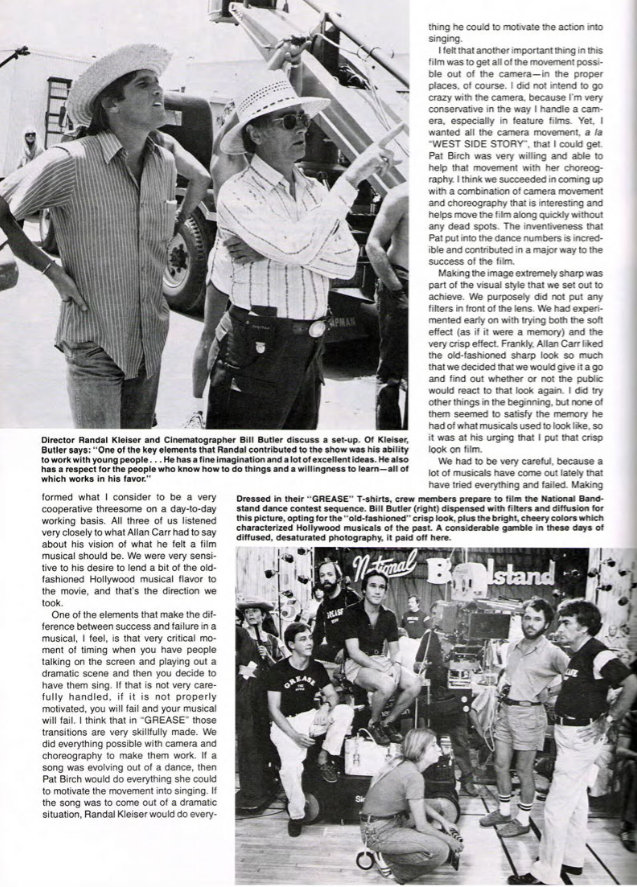
Making the image extremely sharp was part of the visual style that we set out to achieve. We purposely did not put any filters in front of the lens. We had experimented early on with trying both the soft effect (as if it were a memory) and the very crisp effect. Frankly, Allan Carr liked the old-fashioned sharp look so much that we decided that we would give it a go and find out whether or not the public would react to that look again. I did try other things in the beginning, but none of them seemed to satisfy the memory he had of what musicals used to look like, so it was at his urging that I put that crisp look on film.
We had to be very careful, because a lot of musicals have come out lately that have tried everything and failed. Making any film is a huge gamble and everyone in this business is a gambler. A lot of cameramen wouldn't want to take the gamble to go sharp, to go for the old-fashioned crisp look. In this business, it's dangerous to your reputation if you don't succeed - but in this case, it seemed to be the proper choice, and that's really what the cameraman's challenge is all about. It isn't just a matter of coming up with something different. (That's a challenge, too, and I enjoy it.) Your challenge, in the larger sense, is to get the proper look for the film you are making. I feel that the proper choice, in the case of GREASE, was to go the way we went to go bright and cheerful and remembering the day perhaps a little more colorful than it really was, rather than as murky memory.
To explain further my remark that it's dangerous to go for a crisp, old-fashioned look in photographing films today, let me say that in the past ten years cinematography has been influenced by many things: by television, by commercials, by more experimental cameramen working - and the choice of style, more often than not, has been toward a very soft, muted color. The Kodachrome
look or the old Technicolor
look has been out of vogue for some time. To go against that trend, in my opinion, requires some nerve, but that's what this business is all about. If you accept a challenge and decide to go against the trend, you've got to have the steel for it.
Crisp photography makes it harder for a cameraman to flatter the people in front of his lens. The characters portrayed in GREASE
are very young, but the actors and actresses portraying them (except for the chorus) weren't all that young. Many of our leading actresses need a lot of help photographically. Even Olivia Newton-John, as young and beautiful as she is, has to be photographed very carefully. I've found that every actress has some physical characteristic that she doesn't want to show on film, in the case of more mature actresses, the lighting must be done with great care in order to make them look younger and attractive. In photographing GREASE
this required a lot of work and attention (which I hope is not evident in the film). but I enjoyed doing it. I enjoy photographing women and I try to do it well - but it's not always easy.
The most difficult challenge in photographing GREASE
stemmed from the fact that it was shot on location, which is unique for this type of film. To try to shoot a musical on location and make everything look beautiful is really asking for trouble. You are at the mercy of the weather, you are shooting outdoors a lot, and you don't know whether the sun is going to shine or whether it is going to be overcast. On top of that, you have long and difficult dance sequences to match. The challenges were many and great because of those factors.
If I had been in a studio, where all of the conditions could have been controlled, I wouldn't have had to deal with weather. But when you have to cope with weather, you have to be very versatile. You have to be inventive in order to get your scenes shot and match them up - plus, at the same time, capturing the look
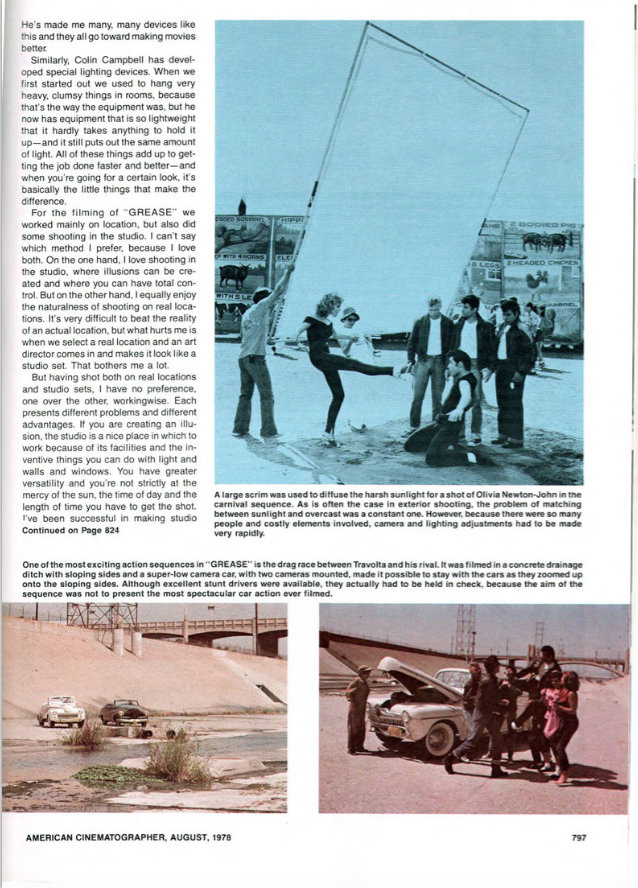
that you are after. These are difficulties which no one who goes to see the movies should ever be aware of, but anyone who makes film must know about the mammoth problems that you can get involved in when you have a football field full of carnival equipment, literally hundreds of dancers, plus all of the other people that have been brought in. Considering the pressures that exist on a production day like that, the amount of money that is involved in every minute it takes you to pull whatever magic out of the hat you can, plus the weather, it requires nerves of steel in order to keep everyone in a positive mood.
Much of GREASE
was shot with dancers doing numbers over and over again. I have no idea how they maintained their physical stamina. To take even a few minutes to adjust something put tremendous pressure on me, because I realized what I was doing to everyone else in the show In spite of that, you still have to get the job done, and when you have to add arcs to make a scene work in the daytime, or when you have to do any major lighting (and everything in this picture was major), you have to do it as fast and as efficiently as you can.
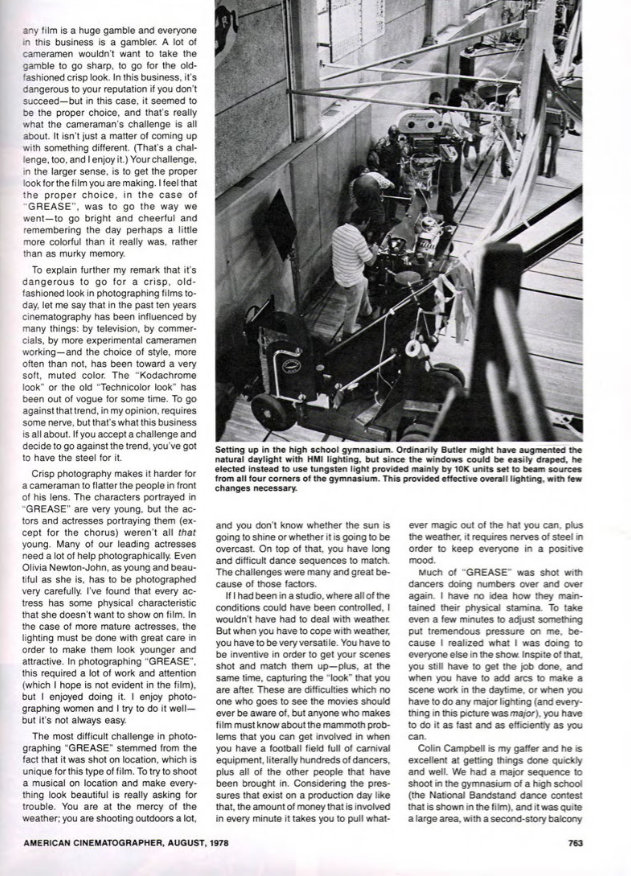
Colin Campbell is my gaffer and he is excellent at getting things done quickly and well. We had a major sequence to shoot in the gymnasium of a high school (the National Bandstand dance contest that is shown in the film), and it was quite a large area, with a second-story balcony around it. We wanted to light this in such a manner that we could go in and shoot all day long without making major changes, and we wanted to get in ahead of time in order to do that. But as fate would have it, someone decided to re-finish the floor a couple of nights before and whatever they put on the floor would not dry, so we were unable to get in there until the night before we were scheduled to shoot. This put tremendous pressure on the gaffer and myself, because we had wanted to see what it would look like in advance so that we wouldn't have to make adjustments once we were in there.
The ability of Colin to handle problems like this to get the lights up and make the adjustments and capture the look that he and I were happy with before we started shooting - is really, in large measure, the key to the success of the big numbers in the film, and nearly everything was a big number.
For the sequences shot in the studio, we had control, but the key to success there was the same as in the gymnasium - namely, to go in ahead of time and decide what you were going to do. Pre-planning is really the only way that you can make a picture of this size. The moment of truth comes when you stand inside a set or a given location and look around and say, Alright, here's what we're going to do
. That's the moment when you roll the dice, because once you decide upon a philosophy and a way to go about your lighting, you have to live with it and make it work. Aside from minor adjustments, you're not going to be able to change it much, because, from the financial standpoint, it just isn't feasible to have a crew pull everything out and put it back in again.
In every case, on this picture, we were successful in deciding upon a philosophy of lighting and having it work. I believe that the show attests to the fact that the desired look
was followed through consistently. While we did many different things in lighting - we didn't light all of the sequences the same, by any means - the gaffer and I tackled each problem separately and tried to do something unique.
In the case of the dance contest sequence, which was shot in the actual high school gymnasium, we used a combination of hard lights, softening them a lot and throwing them a long way. We went for a kind of four-corner
lighting scheme in that instance, in which each of the four corners of the room became a major light source. The philosophy behind that approach was that no matter in what direction we shot, one side would became the key and the other side would become backlight. If you do that from all four corners with a major source of light, you can just about shoot all day long in a set and always have an interesting kind of light. That wasn't the only kind of lighting we did in that room - we supplemented it at times - but it formed the basic plan.
In a set like the gymnasium it would have seemed logical to use HMI units - and I love to use them but since we were able to enclose the set completely, we decided to stay with warm light. We used 10Ks in the comers and supplemented them with other lighting units as needed. We did soften the 10Ks so that the light was not harsh. If you throw those big lights a long distance they will soften themselves, but you will lose intensity. It's a question of how far you are going to throw them and how much you'll need to soften them. In this case, the lights were not so far away that we didn't need to soften them. We did this by putting mate rial in front of the lights so that they started off soft, but the material didn't diminish their intensity very much.
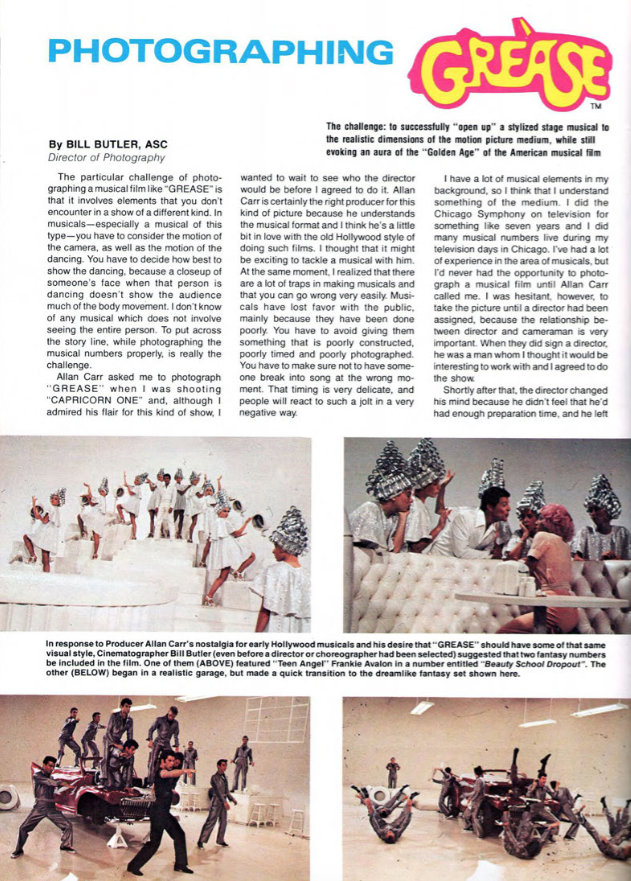
We had other sets that were entirely different - the fantasy sets, for example. which were an invention of mine before the director and choreographer were hired. Going back to the origin of the film and the way that it came about, a lot of that philosophy did fall on Allan Carr and myself when we were faced with the necessity of making such plans. At the same time, the writer, Bronte Woodard. was writing the screenplay and trying to pull it all together before we started shooting. I felt that if we were going to get something of the old film musical feeling into the picture, there should be two fantasy numbers. They were invented out of that kind of logic - to give us something to shoot in the old musical style. Again, it is unusual for a cameraman to make a contribution toward how a show should be structured, but, in this case, I had the opportunity to do a lot of that and I'm quite delighted that the film is so successful, because I put a lot more into it than pictures.
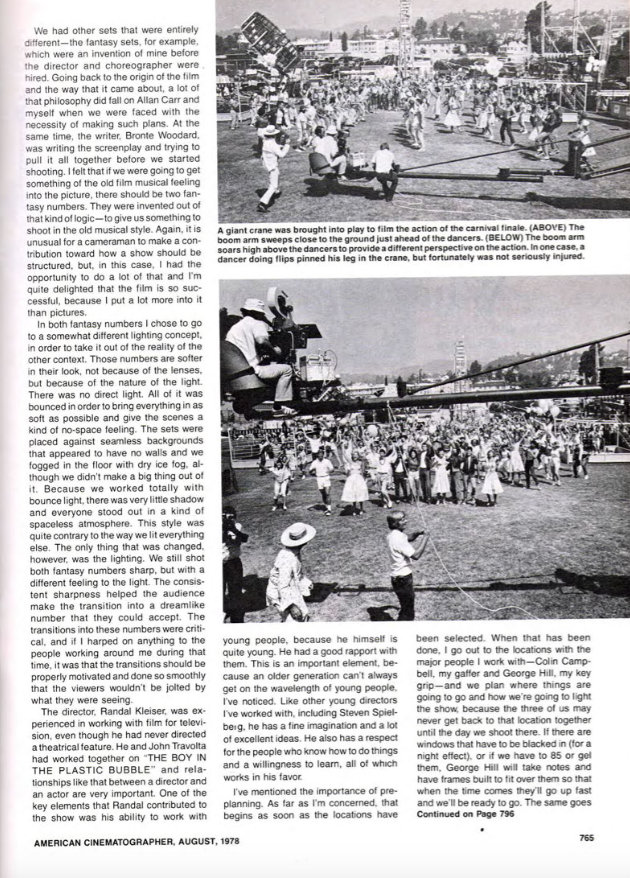
In both fantasy numbers I chose to go to a somewhat different lighting concept, in order to take it out of the reality of the other context. Those numbers are softer in their look, not because of the lenses, but because of the nature of the light. There was no direct light. All of it was bounced in order to bring everything in as soft as possible and give the scenes a kind of no-space feeling. The sets were placed against seamless backgrounds that appeared to have no walls and we fogged in the floor with dry ice fog, although we didn't make a big thing out of it. Because we worked totally with bounce light, there was very little shadow and everyone stood out in a kind of spaceless atmosphere. This style was quite contrary to the way we lit everything else. The only thing that was changed, however, was the lighting. We still shot both fantasy numbers sharp, but with a different feeling to the light. The consistent sharpness helped the audience make the transition into a dreamlike number that they could accept. The transitions into these numbers were critical, and if I harped on anything to the people working around me during that time, it was that the transitions should be properly motivated and done so smoothly that the viewers wouldn't be jolted by what they were seeing.
The director, Randal Kleiser, was experienced in working with film for television, even though he had never directed a theatrical feature. He and John Travolta had worked together on THE BOY IN THE PLASTIC BUBBLE and relationships like that between a director and an actor are very important. One of the key elements that Randal contributed to the show was his ability to work with young people, because he himself is quite young. He had a good rapport with them. This is an important element, because an older generation can't always get on the wavelength of young people. I've noticed. Like other young directors I've worked with, including Steven Spielberg, he has a fine imagination and a lot of excellent ideas. He also has a respect for the people who know how to do things and a willingness to learn, all of which works in his favor.
.I've mentioned the importance of pre-planning. As far as I'm concerned, that begins as soon as the locations have been selected. When that has been done, I go out to the locations with the major people I work with - Colin Campbell, my gaffer and George Hill, my key grip - and we plan where things are going to go and how we're going to light the show because the three of us may never get back to that location together until the day we shoot there. If there are windows that have to be blacked in (for a night effect), or if we have to 85 or gel them, George Hill will take notes and have frames built to fit over them so that when the time comes they'll go up fast and we'll be ready to go. The same goes for special rigs that have to be built. If Colin and George, my two generals
are successful in getting their work done efficiently ahead of time, then the production will move so smoothly that people will think it's easy - and that's the way we want it to look. All of it, though, is pre-planned, there is no other way.
Pre-planning includes a multitude of items, such as: where the generator is going to go, where the cables are going to be run, how to get the power where you want it, if you're working on the fifth floor of some building, how to get the equipment up there, what entrance to use. All of that has to be worked out in advance.
From the cinematographer's stand-point, one of the most important pre-planning decisions is the type of lighting that is to be used eventually in the particular rooms where shooting is to take place. In many cases, the lighting I use requires spreaders, which George Hill will make to hold the lights that Colin Campbell will put on them. I do a lot of very special kinds of lighting, using special equipment that Colin has found or developed and special methods of masking the lights that George has worked out. We have a lot of this special equipment that we have developed over the period of time that we've been together. We have to decide what we will need where, and what we'll have to build. What will work in one room won't necessarily work in another room. If a ceiling is too low for us to go overhead with our lights, we'll have to figure out some other place to put them. All of these decisions are made before we start shooting. That doesn't mean that we may not change our minds, because conditions have a way of changing on location, but we go in with a plan that we try to stick to very closely.
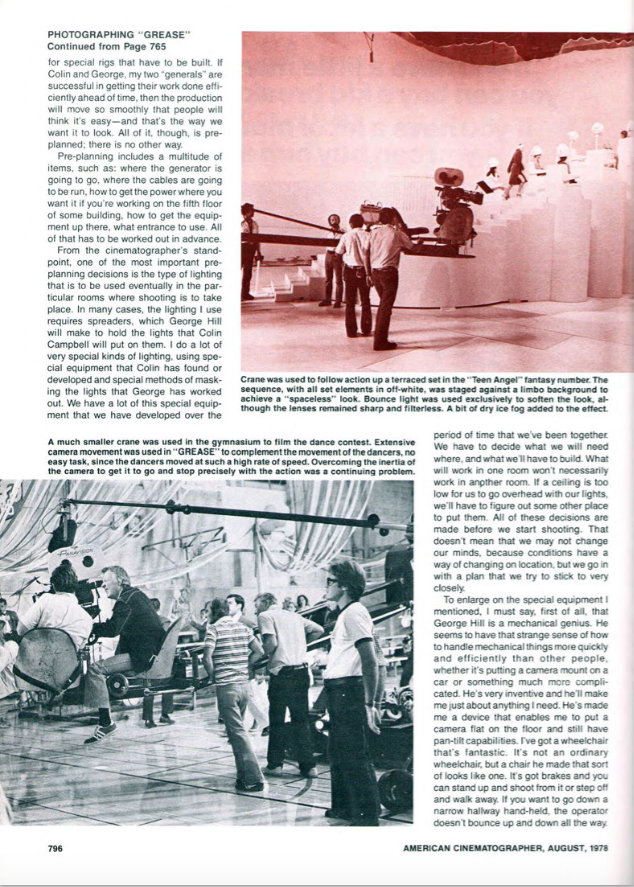
To enlarge on the special equipment I mentioned, I must say, first of all, that George Hill is a mechanical genius. He seems to have that strange sense of how to handle mechanical things more quickly and efficiently than other people, whether it's putting a camera mount on a car or something much more complicated. He's very inventive and he'll make me just about anything I need. He's made me a device that enables me to put a camera flat on the floor and still have pan-tilt capabilities. I've got a wheelchair that's fantastic. It's not an ordinary wheelchair, but a chair he made that sort of looks like one. It's got brakes and you can stand up and shoot from it or step off and walk away. If you want to go down a narrow hallway hand-held, the operator doesn't bounce up and down all the way.
He's made me many, many devices like this and they all go toward making movies better.
Similarly, Colin Campbell has developed special lighting devices. When we first started out we used to hang very heavy, clumsy things in rooms, because that's the way the equipment was, but he now has equipment that is so lightweight that it hardly takes anything to hold it up - and it still puts out the same amount of light. All of these things add up to getting the job done faster and better - and when you're going for a certain look, it's basically the little things that make the difference.
For the filming of GREASE
we worked mainly on location, but also did some shooting in the studio. I can't say which method I prefer, because I love both. On the one hand, I love shooting in the studio, where illusions can be created and where you can have total control. But on the other hand, I equally enjoy the naturalness of shooting on real locations. It's very difficult to beat the reality of an actual location, but what hurts me is when we select a real location and an art director comes in and makes it look like a studio set. That bothers me a lot.
But having shot both on real locations and studio sets, I have no preference, one over the other, working wise. Each presents different problems and different advantages. If you are creating an illusion, the studio is a nice place in which to work because of its facilities and the inventive things you can do with light and walls and windows. You have greater versatility and you're not strictly at the mercy of the sun, the time of day and the length of time you have to get the shot. I've been successful in making studio sets look like they were the real thing shot on location, sometimes cutting from one to the other with no one being able to tell the difference. I like to feel that I'm versatile enough to do either. They present different challenges and I like them for different reasons.
In shooting the car race sequence for GREASE
we used one piece of equipment that I feel was quite unusual. It was a chase car that was very small and built very close to the ground. It looked a little bit like a dune buggy, but was even lower. The entire car was probably not even three feet off the ground, but we could work two cameras off of it - or more for that matter.
During the course of filming the race, we were running up on the sides of a drainage canal and I don't know how many degrees of slope it was, but I kept feeling that we were going to roll off of it and tum over. The fact that this chase car was so low to the ground is what made it possible to get some quite unusual footage while going very fast on the sides of those slopes. Otherwise it would have been impossible.
Our purpose in shooting this car race sequence was not to make it the most exciting car race in the world, because it would be difficult to top the people who have done it better with a lot more equipment, but we had excellent stunt people working for us and we really had to hold them down. We had to tell them that we didn't want them to crash cars or do fantastic, impossible jumps. The objective was not to make the cars too sensational, but simply to convey the feeling of danger arising out of the competition between the two characters in the story. As a result, we had to pass on some of the spectacular ideas which the stunt people had for us (and which they could have handled very well) in the interest of pulling the race sequence down.
Even so, I feel that it's quite exciting on the screen, especially the part where the two cars run up over a drainage outlet on the side of the slope. I think that's more exciting than some of the fantastic scenes where you see cars jumping off of bridges and just barely making it to the other side. Our race ends up with their trying to jump a little stream. One guy doesn't make it at all and the other nearly breaks up. They jump off a ramp that was only about a foot high because that's the way we wanted it. We didn't want the most fantastic car antics in the world. because they would have been wrong for the story.
The major locations for GREASE
were three actual high schools and it was difficult shooting on those campuses be cause initially classes were just letting out for summer and then we ran into summer school. We sometimes weren't able to get into the schools at the times we wanted to shoot, which caused some unpleasantness, but everything was shot in and around Los Angeles, which saved the producers a lot of money.
I mentioned earlier that one of the primary elements in the photographic style adopted for GREASE
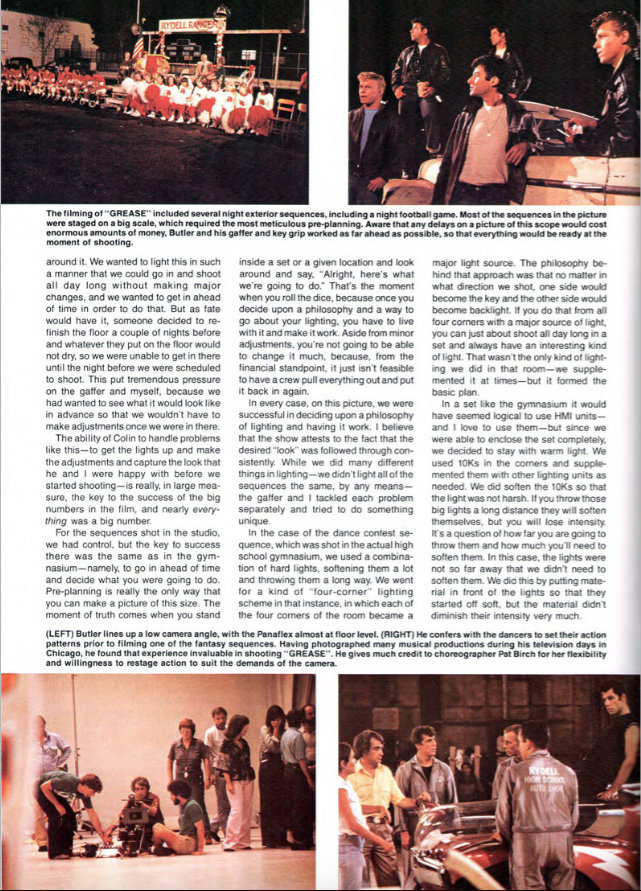
was the use of extensive camera movement to complement the movement of the dancers. That being the case, we put the camera on tracks a lot so that we could get it going fast. Those dancers move at incredible speeds, so the problem in trying to go with them is just overcoming the inertia of the camera. Simply getting it going is a project in itself. There were many times when the scene behind the camera was more hilarious than the antics going on in front of it, because just the number of people and ropes and grips involved in getting the camera going and trying to get it stopped added up to a real comedy sequence.
We used cranes when we were out-doors and had lots of room-for example, the huge crane used in the final carnival sequence. But we found out that a crane can be very dangerous when you've got dancers working close to it. Usually, when you work with a crane, you are far away from any action, but in this case we were using the crane to cover distance and pivot on its center point, so that as the dancers would sweep toward us, we could move away from them over the ground as if we were dollying. The big advantage would be that we wouldn't have the problem of dolly track showing.
We were using the crane in this manner, when one of the dancers who did a beautiful flip in the air during rehearsal decided on the take to do two flips in the air. On the second flip he flew right into the crane and got his leg caught in between one of the guide arms and the crane itself, so that he was trapped in there. We were moving and the crane was sweeping over the ground at a high rate of speed and we were certain that he was going to have a broken leg when we got him out of there. Miraculously he did not break his leg, although he hurt it, but it was evidently not too serious of an injury because he was back in there dancing the next day. He went back and did the same flip again and we got the shot.
All of the dancers who performed in GREASE
seemed to be very athletic and able to do a lot of gymnastic things in their dancing, but there were times when just the amount of energy and physical activity going on around the camera would make it dangerous to them. To their credit, I must say that those dancers didn't hold back anything. Their nerve and desire to get the best possible result on film were just unbelievable. Working on a musical you gain a great respect for the dancers because of their willingness to give you the best that they possibly can. I can't quite understand that kind of energy and endurance, but certainly the dancers in GREASE
gave everything they had - and it was wonderful to see.
I've been asked whether we used the STEADICAM or the PANAGLIDE (we were using Panavision equipment) in shooting GREASE
. There were times when we felt that we might go that route - and it seemed like a good idea - but I didn't actually find any place where it would fit. It would seem to work best for chases and fast runs upstairs and things like that, but for our purposes the crane seemed to work better. It gave us more control and enabled us to swing up and over the action at times. I'm sure that, used in the right place, a device like the PANAGLIDE can be exceptionally dramatic, but what I wanted was controlled movement that could be very precise, because the dances were very precise. Consequently, in order to get the best out of Pat Birch's choreography, we used dollies and cranes.
Photographing GREASE
presented an almost endless series of challenges. but I feel that we met those challenges successfully and I'm happy with the result on the screen.
(ABOUT THE AUTHOR: BILL BUTLER, ASC was nominated for an Academy Award for his photography of ONE FLEW OVER THE CUCKOO'S NEST (together with Haskell Wexler, ASC) in 1975. That same year he served as Director of Photography of JAWS which, until STAR WARS, was the biggest grossing film of all time.
Born in Colorado, Butler began his career in films working with then-novice director William Friedkin on a series of documentaries in Chicago. One of them, THE PEOPLE VS PAUL CRUMP, not only won the pair the top award at the San Francisco Film Festival, also reversed the practice of capital punishment in Chicago because of its impact. Friedkin brought Bill with him to work on his GOOD TIMES starring Sonny and Cher. He then worked with Jack Nicholson on DRIVE, HE SAID, and with Francis Ford Coppola on one of his earliest features, THE RAIN PEOPLE Coppola called upon Butler to photograph his critically acclaimed, Academy Award-nominated THE CONVERSATION, and then came assignments to work with Milos Forman on CUCKOO'S NEST and with Steven Spielberg on JAWS2
Having started as an electronics engineer, Butler still likes to work in television where his photography for RAID ON ENTEBBE and THE EXECUTION OF PRIVATE SLOVICK has been appreciated by critics and public alike.)