
Olivia Newton-John Interview
70sthanks to Kay
Click to enlarge
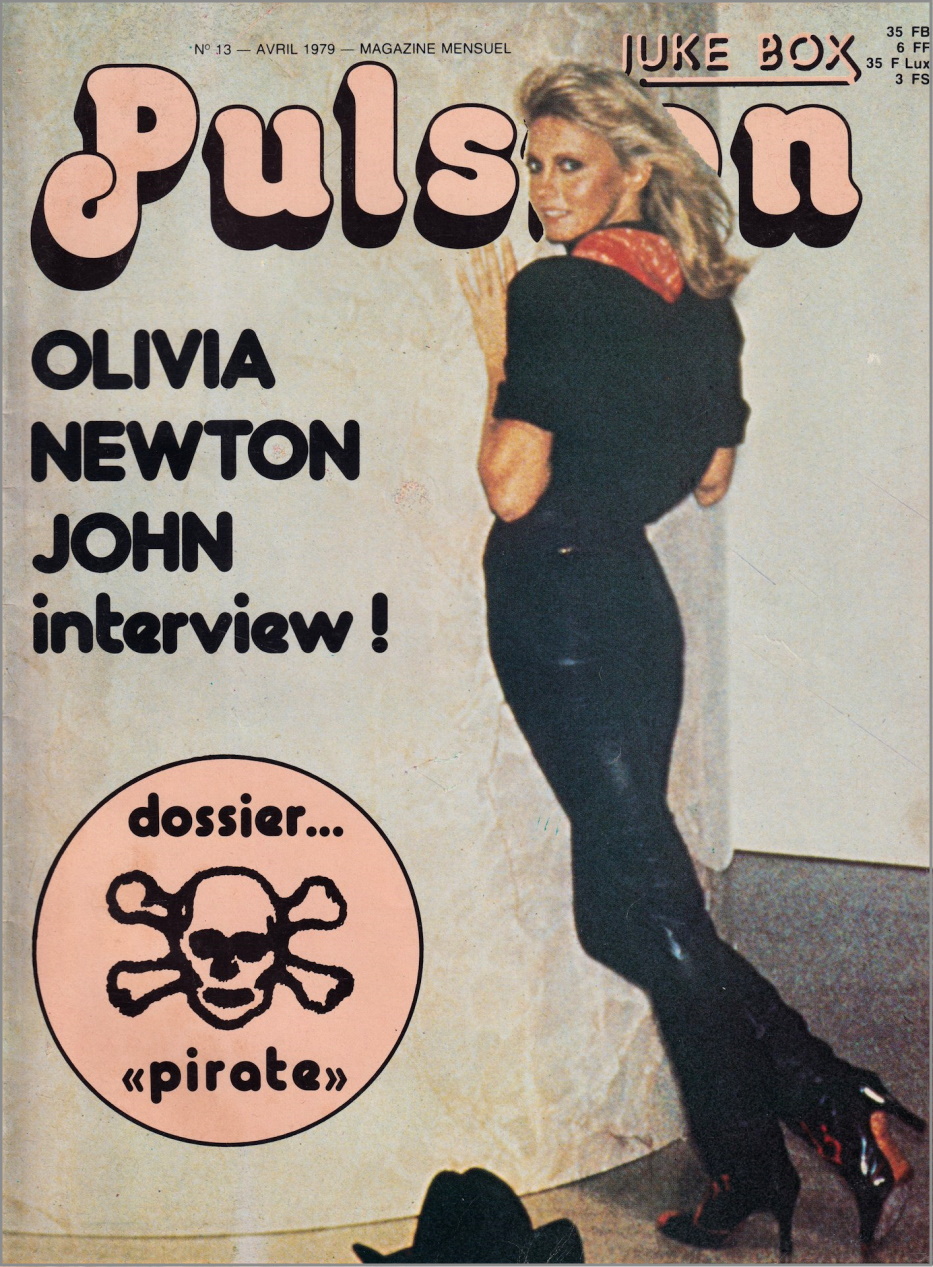
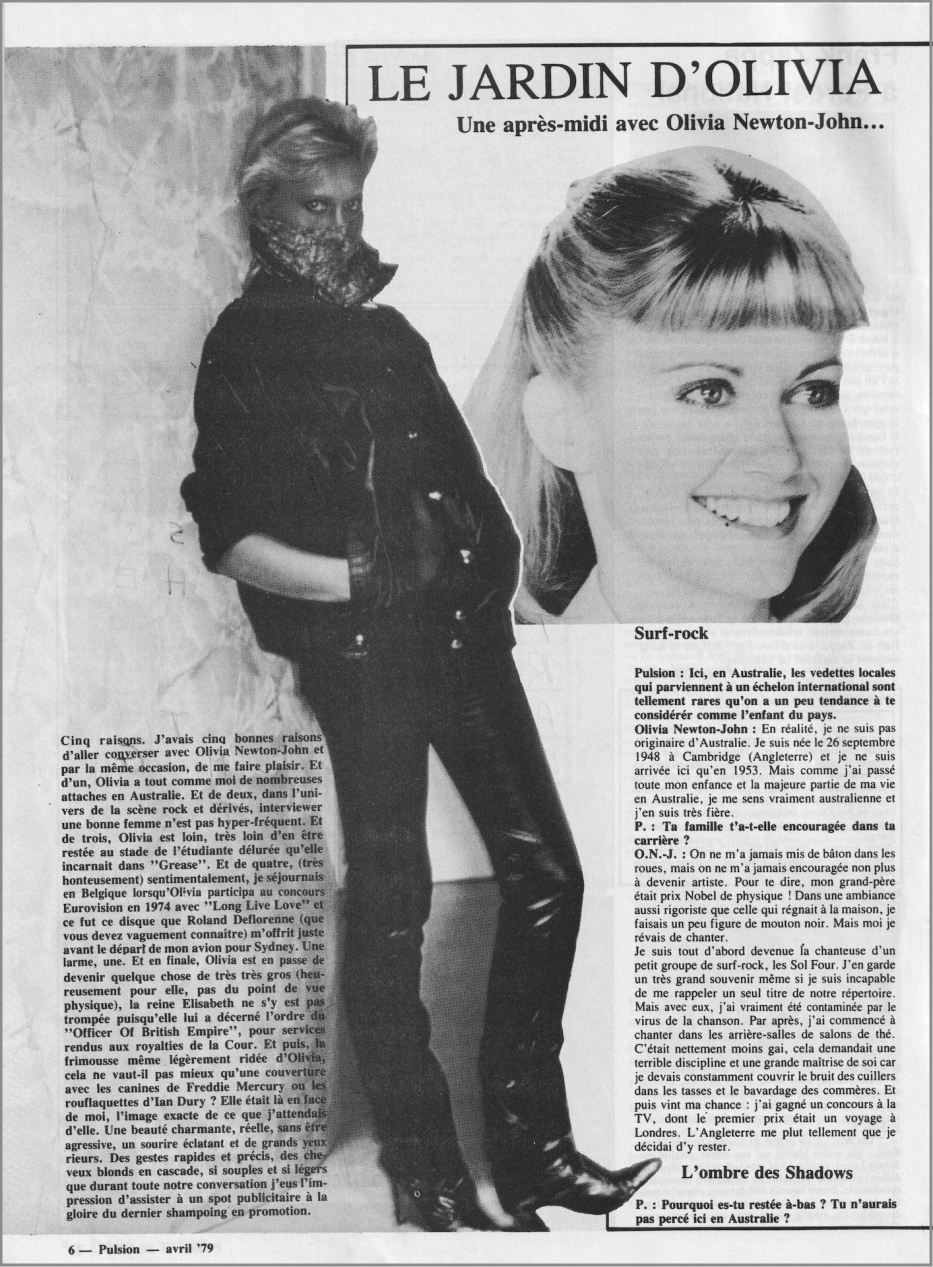
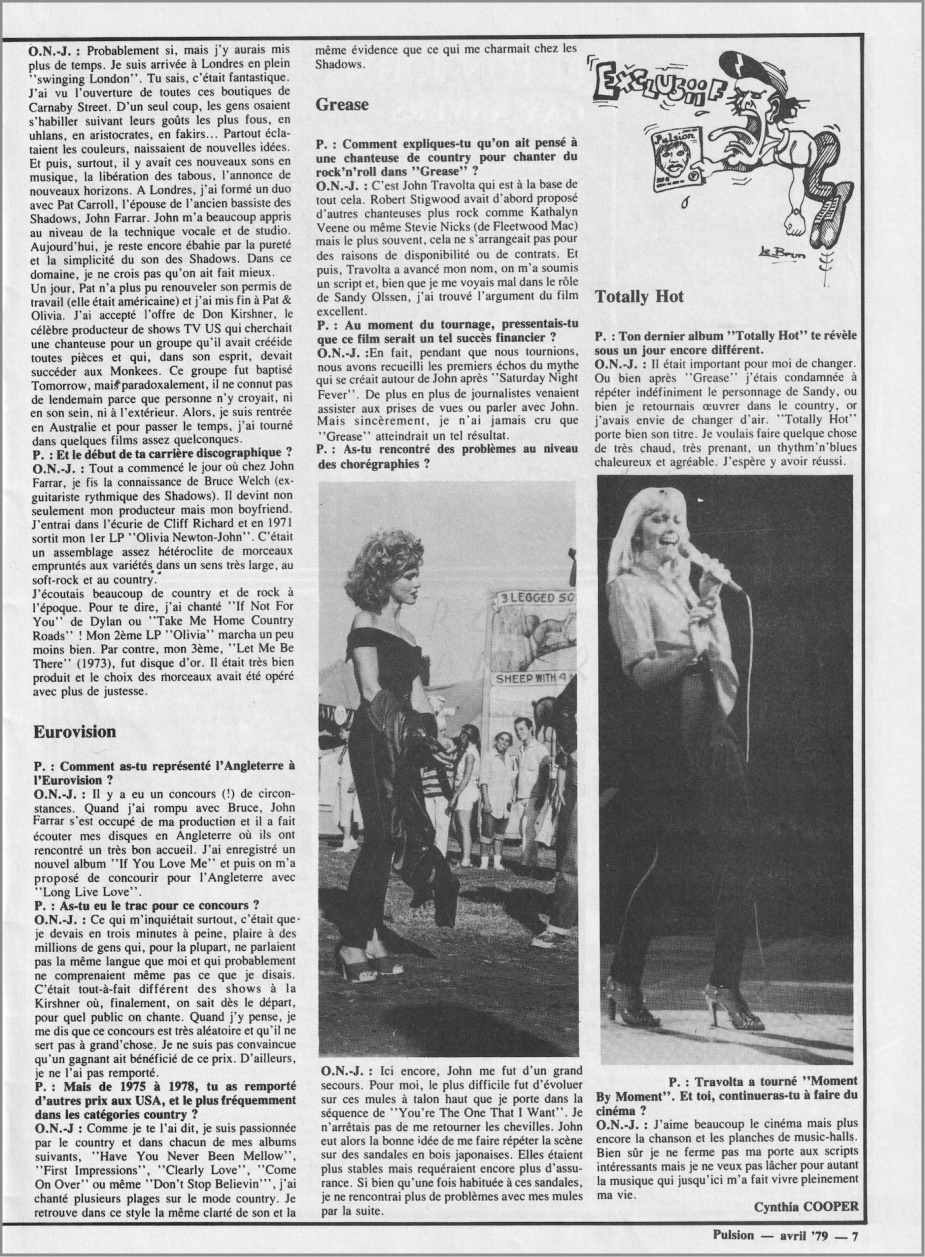
Issue Number 13
Translation:
Five reasons. I had five good reasons to go and chat with Olivia Newton-John and, at the same time, to treat myself.
One, Olivia has, like me, many ties to Australia. And two, in the world of the rock scene and its derivatives, interviewing a good woman is not very common. And three, Olivia is far, very far from having remained at the stage of the sassy student she played in Grease.
And four, (very shamefully) sentimentally, I was staying in Belgium when Olivia participated in the Eurovision Song Contest in 1974 with Long Live Love
and it was this record that Roland Deflorenne (whom you must vaguely know) gave me just before my plane left for Sydney. And finally, Olivia is about to become something very, very big (fortunately for her, not from a physical point of view), Queen Elizabeth did not make a mistake when she awarded her the order of Officer Of The British Empire
, for services rendered to royalties of the Court.
And then, Olivia's face, even slightly wrinkled, is it not better than a cover with Freddie Mercury's canines, or Ian Dury's sideburns? There she was in front of me, the exact image of what I expected of her.
A charming beauty, real, without being aggressive, a dazzling smile and big laughing eyes. Quick and precise gestures, cascading blond hair, so soft and so light that during our entire conversation I had the impression of watching a commercial glorifying the latest shampoo on sale.
The Interview
Pulsion: Here in Australia, local stars who reach international heights are so rare that we tend to think of you as a local girl.
Olivia Newton-John: Actually, I'm not originally from Australia. I was born on September 26, 1948, in Cambridge, England, and I only arrived here in 1953. But since I spent my entire childhood and most of my life in Australia, I feel very Australian and I'm very proud of it.
Pulsion: Did your family encourage your career?
O.N.-J. No one ever put a spanner in the works, but no one ever encouraged me to become an artist either. To tell you the truth, my grandfather was a Nobel Prize winner in physics! In an atmosphere as strict as the one at home, I was a bit of a black sheep. But I dreamed of singing. I first became the singer of a small folk band, the Sol Four. I have very fond memories of it, even though I can't remember a single song from our repertoire. But with them, I was really infected by the singing virus. Later, I started singing in the back rooms of tea shops. It was much less cheerful, it required terrible discipline and great self-control because I constantly had to cover the sound of spoons in cups and the chatter of gossips. And then came my chance: I won a TV competition, the first prize of which was a trip to London. I liked England so much that I decided to stay there.
The Shadow of the Shadows
Pulsion: Why did you stay there? Wouldn't you have made it here in Australia?
O.N.-J. Probably yes, but it would have taken me longer. I arrived in London in the middle of swinging London.
You know, it was fantastic. I saw all those shops opening on Carnaby Street. Suddenly, people dared to dress according to their wildest tastes, as Uhlans, aristocrats, fakirs... Colors were bursting everywhere, new ideas were born. And then, above all, there were these new sounds in music, the liberation of taboos, the announcement of new horizons. In London, I formed a duo with Pat Carroll, the wife of former Shadows bassist John Farrar. John taught me a lot about vocal and studio technique. Today, I'm still amazed by the purity and simplicity of the Shadows' sound. In this area, I don't think we've done better. One day, Pat could no longer renew her work permit (she was American) and I ended Pat & Olivia. I accepted the offer of Don Kirshner, the famous US TV show producer who was looking for a singer for a band he had created from scratch and which, in his mind, was to succeed the Monkees. This group was called Toomorrow, but paradoxically, it didn't have a future because no one believed in it, neither within nor outside. So, I returned to Australia and to pass the time, I acted in a few rather ordinary films.
Pulsion: And the beginning of your recording career?
O.N.-J. It all started the day at John Farrar's house, I met Bruce Welch (ex-rhythm guitarist of the Shadows). He became not only my producer but my boyfriend. I joined Cliff Richard's show and in 1971 released my first LP Olivia Newton-John
. It was a rather heterogeneous collection of songs borrowed from pop in a very broad sense, soft-rock and country. I listened to a lot of country and rock at the time. To give you an idea, I sang Dylan's If Not For You
and Take Me Home Country Roads
! My second LP Olivia
did a little less well. On the other hand, my third, Let Me Be There
(1973), went gold. It was very well produced and the choice of songs had been made with greater precision.
Eurovision
Pulsion: How did you represent England at Eurovision?
O.N.-J. It was a combination (!) of circumstances. When I broke up with Bruce, John Farrar took care of my production and he played my records in England where they were very well received. I recorded a new album If You Love Me
and then I was asked to compete for England with Long Live Love
.
Pulsion: Were you nervous about this competition?
O.N.-J. What worried me most was that in just three minutes I had to please millions of people who, for the most part, didn't speak the same language as me and who probably didn't even understand what I was saying. It was completely different from Kirshner-style shows where, ultimately, you know from the start what audience you're singing for. When I think about it, I tell myself that this competition is very random and that it doesn't serve much purpose. I'm not convinced that a winner benefited from this prize. Besides, I didn't win it.
Pulsion: But from 1975 to 1978, you won other prizes in the USA, and most frequently in the country categories?
O.N.-J: As I told you, I am passionate about country and in each of my following albums, Have You Never Been Mellow
, First Impressions
, Clearly Love
, Come On Over
or even Don't Stop Believin'
, I sang several songs in the country mode. I find in this style the same clarity of sound and the same obviousness as what charmed me about the Shadows.
Grease
Pulsion: How do you explain that they thought of a country singer to sing rock'n'roll in Grease
?
O.N.-J. It was John Travolta who was at the base of all this. Robert Stigwood had first suggested other, more rock singers like Kathalyn Veene or even Stevie Nicks (of Fleetwood Mac) but most often, it didn't work out for reasons of availability or contracts. And then, Travolta put my name forward, they submitted a script to me and, although I couldn't see myself in the role of Sandy Olssen, I found the plot of the film excellent.
Pulsion: At the time of filming, did you have a feeling that this film would be such a financial success?
O.N.-J. In fact, while we were filming, we picked up the first echoes of the myth that was being created around John after Saturday Night Fever
. More and more journalists were coming to watch the shooting or talk to John. But honestly, I never thought Grease
would achieve such a result.
Pulsion: Did you encounter any problems with the choreography?
O.N.-J. Here again, John was a great help to me. For me, the most difficult thing was walking on the high-heeled mules I wore in the You're The One That I Want
sequence. I kept twisting my ankles. John then had the good idea of having me rehearse the scene in Japanese wooden sandals. They were more stable but required even more confidence. So once I got used to these sandals, I had no more problems with my mules after that.
Totally Hot
Pulsion: Your latest album, Totally Hot,
reveals you in yet another light.
O.N.-J: It was important for me to change. Either after Grease,
I was doomed to repeat the character of Sandy indefinitely, or I would return to working in country music, and I wanted a change of scenery. Totally Hot
is aptly titled. I wanted to make something very hot, very gripping, a warm and pleasant rhythm 'n' blues. I hope I succeeded.
Pulsion.: Travolta shot Moment By Moment.
And you, will you continue to make films?
O.N.-J. I love cinema a lot, but even more so singing and music hall stages. Of course, I'm not closing my door to interesting scripts, but I don't want to give up music, which has allowed me to live my life to the fullest.
By Cynthia Cooper