
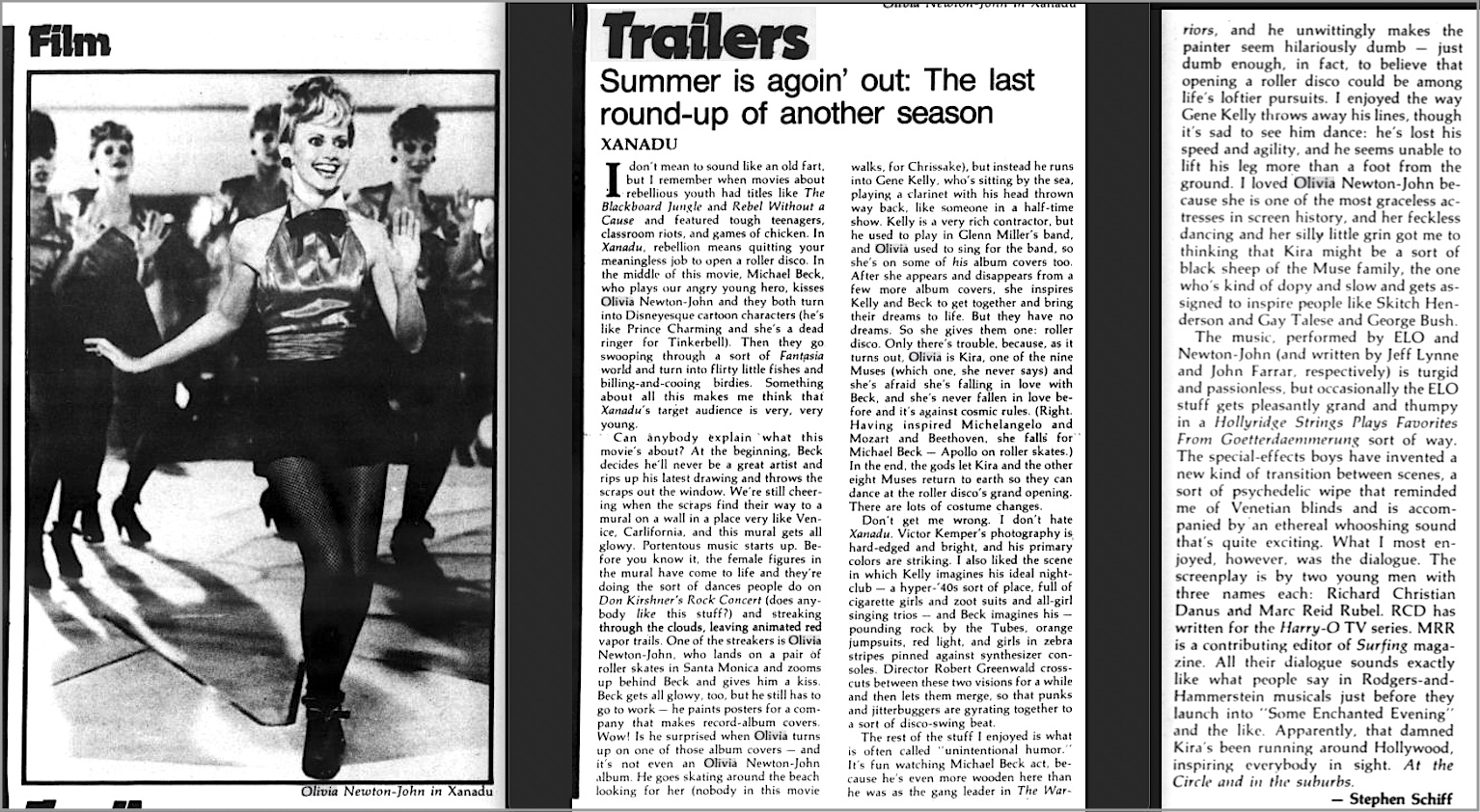
Xanadu review
I don’t mean to sound like an old fart, but I remember when movies about rebellious youth had titles like The Blackboard Jungle and Rebel Without a Cause and featured tough teenagers, classroom riots, and games of chicken. In Xanadu, rebellion means quitting your meaningless job to open a roller disco.
In the middle of this movie, Michael Beck, who plays our angry young hero, kisses Olivia Newton-John and they both turn into Disneyesque cartoon characters (he’s like Prince Charming and she’s a dead ringer for Tinkerbell). Then they go swooping through a sort of Fantasia world and turn into flirty little fishes and hilling-and-cooing birdies. Something about all this makes me think that Xanadu’s target audience is very, very young.
Can anybody explain what this movie’s about? At the beginning, Beck decides he’ll never be a great artist and rips up his latest drawing and throws the scraps out the window, We’re still cheering when the scraps find their way to a mural on a wall in a place very like Venice California, and this mural gets all glowy. Portentous music starts up. Before you know it, the female figures in the mural have come to life and they’re doing the sort of dances people do on Don Kirshner’s Rock Concert (does any body like this stuff?) and streaking through the clouds, leaving animated red vapor trails.
One of the streakers is Olivia Newton-John, who lands on a pair of roller skates in Santa Monica and zooms up behind Beck and gives him a kiss Beck gets all glowy, too, but he still has to go to work he paints posters for a company that makes record-album covers. Wow! Is he surprised when Olivia turns up on one of those album covers and it’s not even an Olivia Newton-John album.
He goes skating around the beach looking for her (nobody in this movie walks, for Chrissake), but instead he runs into Gene Kelly, who’s sitting by the sea, playing a clarinet with his head thrown way back like someone in a half-time show.
Kelly is a very rich contractor, but he used to play in Glenn Miller’s band, and Olivia used to sing for the band, so she’s on some of his album covers too. After she appears and disappears from a few more album covers, she inspires Kelly and Beck to get together and bring their dreams to life. But they have no dreams. So she gives them one roller disco.
Only there’s trouble, because, as it turns out, Olivia is Kira, one of the nine Muses (which one, she never says) and she’s afraid she’s falling in love with Beck, and she’s never fallen in love before and it’s against cosmic rules. (Right. Having inspired Michelangelo and Mozart and Beethoven she falls for Michael Beck Apollo on roller skates) In the end, the gods let Kira and the other eight Muses return to earth so they can dance at the roller disco’s grand opening. There are lots of costume changes.
Don’t get me wrong. I don’t hate Xanadu. Victor Kemper’s photography is hard-edged and bright, and his primary colors are striking. I also liked the scene in which Kelly imagines his ideal nightclub a hyper-40s sort of place, full of cigarette girls and zoot suits and and all-girl singing trios and Beck imagines his-pounding rock by the Tubes, orange jumpsuits, red light, and girls in zebra stripes pinned against synthesizer con-sales. Director Robert Greenwald cross-cuts between these two visions for a while and then lets them merge so that punks and jitterbuggers are gyrating together to a sort of disco-swing beat.
The rest of the stuff I enjoyed is what is often called unintentional humor. It’s fun watching Michael Beck act, because he’s even more wooden here than he was as the gang leader in The Warriors, and he unwittingly makes the painter seem hilariously dumb just dumb enough, in fact, to believe that opening a roller disco could be among life’s loftier pursuits.
I enjoyed the way Gene Kelly throws away his lines, though it’s sad to see him dance: he’s lost his speed and agility, and he seems unable to lift his leg more than a foot from the ground.
I loved Olivia Newton-John because she is one of the most graceless actresses in screen history, and her feckless dancing and her silly little grin got me to thinking that Kira might be a sort of black sheep of the Muse family, the one who’s kind of dopy and slow and gets assigned to inspire people like Skitch Henderson and Gay Talese and George Bush.
The music, performed by ELO and Newton-John (and written by Jeff Lynne and John Farrar, respectively) is turgid and passionless, but occasionally the ELO stuff gets pleasantly grand and thumpy in a Hollyridge Strings Plays Favorites From Goetterdaemmerung sort of way. The special-effects boys have invented a new kind of transition between scenes, a sort of psychedelic wipe that reminded me of Venetian blinds and is accompanied by an ethereal whooshing sound that’s quite exciting.
What I most enjoyed, however, was the dialogue. The screenplay is by two young men with three names each: Richard Christian Danus and Marc Reid Rubel. RCD has written for the Harry-O TV series. MRR is a contributing editor of Surfing magazine. All their dialogue sounds exactly like what people say in Rodgers-and-Hammerstein musicals just before they launch into “Some Enchanted Evening” and the like.
Apparently, that damned Kira’s been running around Hollywood, inspiring everybody in sight. At the Circle and in the suburbs.
By Stephen Schiff