
The Art Of Video Production
80sthanks to Kay
Click to enlarge
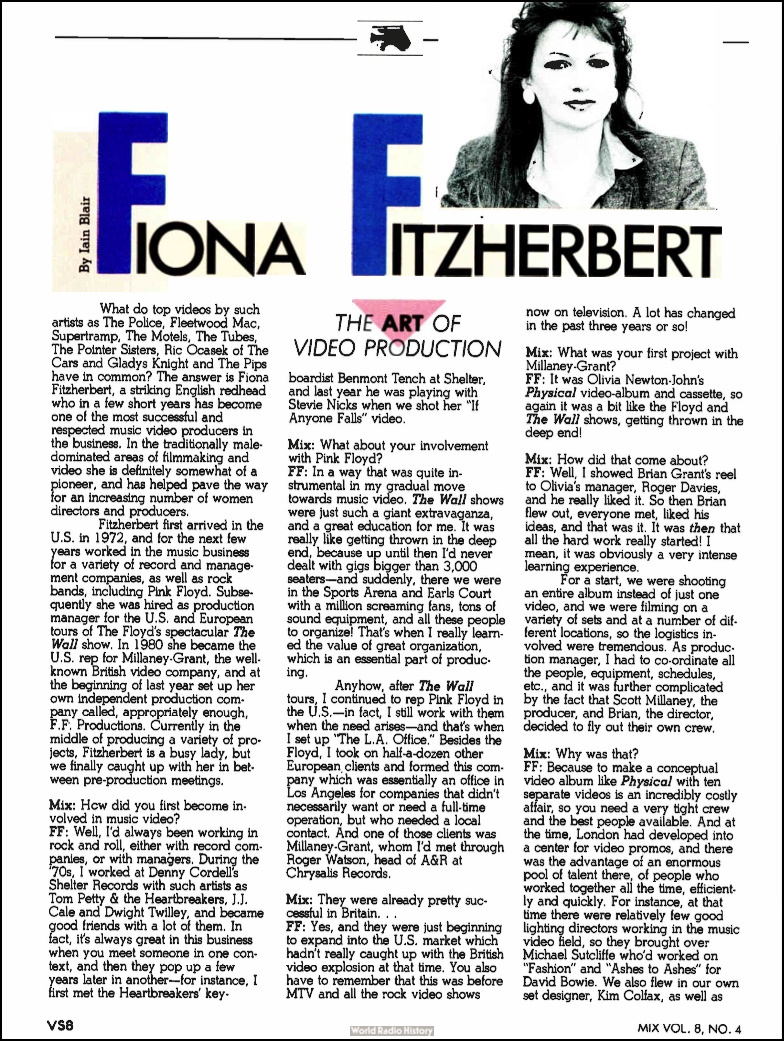
Fiona Fizherbert
What do top videos by such artists as The Police, Fleetwood Mac, Supertramp, The Motels, The Tubes, The Pointer Sisters, Ric Ocasek of The Cars and Gladys Knight and The Pips have in common? The answer is Fiona Fitzherbert, a striking English redhead who in a few short years has become one of the most successful and respected music video producers in the business. In the traditionally male-dominated areas of film making and video she is definitely somewhat of a pioneer, and has helped pave the way for an increasing number of women directors and producers.
Fitzherbert first arrived in the U.S. in 1972, and for the next few years worked in the music business for a variety of record and management companies, as well as rock bands, including Pink Floyd. Subsequently she was hired as production manager for the U.S. and European tours of The Floyd's spectacular The Wall show. In 1980 she became the U.S. rep for Millaney Grant, the well known British video company, and at the beginning of last year set up her own independent production company called, appropriately enough, F.F. Productions.
Currently in the middle of producing a variety of projects, Fitzherbert is a busy lady, but we finally caught up with her in between pre-production meetings.
Mix: How did you first become involved in music video?
Fiona Fizherbert: Well, I'd always been working in rock and roll, either with record companies, or with managers. During the '70s, I worked at Denny Cordell's Shelter Records with such artists as Tom Petty & the Heartbreakers, J.J. Cale and Dwight Twilley, and became good friends with a lot of them. In fact, it's always great in this business when you meet someone in one con-text, and then they pop up a few years later in another-for instance, I first met the Heartbreakers' keyboardist Benmont Tench at Shelter, and last year he was playing with Stevie Nicks when we shot her If Anyone Falls
video.
Mix: What about your involvement with Pink Floyd?
FF: In a way that was quite instrumental in my gradual move towards music video. The Wall shows were just such a giant extravaganza, and a great education for me. It was really like getting thrown in the deep end, because up until then I'd never dealt with gigs bigger than 3,000 seaters - and suddenly, there we were in the Sports Arena and Earls Court with a million screaming fans, tons of sound equipment, and all these people to organize! That's when I really learned the value of great organization, which is an essential part of producing.
Anyhow, after The Wall tours, I continued to rep Pink Floyd in the U.S.- in fact, I still work with them when the need arises and that's when I set up The L.A. Office.
Besides the Floyd, I took on half-a-dozen other European clients and formed this company which was essentially an office in Los Angeles for companies that didn't necessarily want or need a full-time operation, but who needed a local contact. And one of those clients was Millaney Grant, whom I'd met through Roger Watson, head of A&R at Chrysalis Records.
Mix: They were already pretty successful in Britain...
FF: Yes, and they were just beginning to expand into the U.S. market which hadn't really caught up with the British video explosion at that time. You also have to remember that this was before MTV and all the rock video shows now on television. A lot has changed in the past three years or so!
Mix: What was your first project with Millaney-Grant?
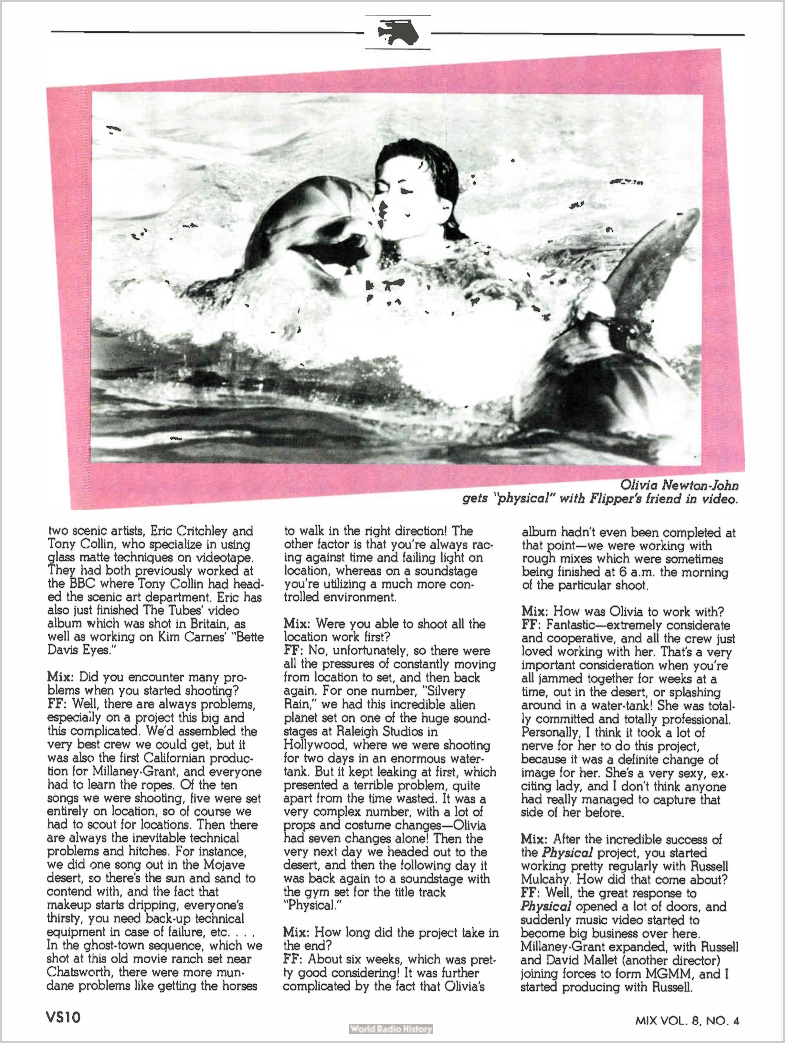
Fiona Fizherbert: It was Olivia Newton-John's Physical video-album and cassette, so again it was a bit like the Floyd and The Wall shows, getting thrown in the deep end!
Mix: How did that come about?
FF: Well, I showed Brian Grant's reel to Olivia's manager, Roger Davies, and he really liked it. So then Brian flew out, everyone met, liked his ideas, and that was it. It was then that all the hard work real really started! I mean, it was obviously a very intense learning experience.
For a start, we were shooting an entire album instead of just one video, and we were filming on a variety of sets and at a number of different locations, so the logistics involved were tremendous. As production manager, I had to co-ordinate all the people, equipment, schedules, etc., and it was further complicated by the fact that Scott Millaney, the producer, and Brian, the director, decided to fly out their own crew.
Mix: Why was that?
FF: Because to make a conceptual video album like Physical with ten separate videos is an incredibly costly affair, so you need a very tight crew and the best people available. And at the time, London had developed into a center for video promos, and there was the advantage of an enormous pool of talent there, of people who worked together all the time, efficiently and quickly. For instance, at that time there were relatively few good lighting directors working in the music video field, so they brought over Michael Sutcliffe who'd worked on Fashion
and Ashes to Ashes
for David Bowie. We also flew in our own set designer, Kim Colfax, as well as two scenic artists, Eric Critchley and Tony Collin, who specialize in using glass matte techniques on videotape. They had both previously worked at the BBC where Tony Collin had headed the scenic art department. Eric has also just finished The Tubes' video album which was shot in Britain, as well as working on Kim Carnes' Bette Davis Eyes.
Mix: Did you encounter many problems when you started shooting?
FF: Well, there are always problems, especially on a project this big and this complicated. We'd assembled the very best crew we could get, but it was also the first Californian production for Millaney-Grant, and everyone had to learn the ropes. Of the ten songs we were shooting, five were set entirely on location, so of course we had to scout for locations. Then there are always the inevitable technical problems and hitches.
For instance, we did one song out in the Mojave desert, so there's the sun and sand to contend with, and the fact that makeup starts dripping, everyone's thirsty, you need back-up technical equipment in case of failure, etc.... In the ghost-town sequence, which we shot at this old movie ranch set near Chatsworth, there were more mundane problems like getting the horses to walk in the right direction! The other factor is that you're always racing against time and failing light on location, whereas on a soundstage you're utilizing a much more controlled environment.
Mix: Were you able to shoot all the location work first?
FF: No, unfortunately, so there were all the pressures of constantly moving from location to set, and then back again. For one number, Silvery Rain,
we had this incredible alien planet set on one of the huge soundstages at Raleigh Studios in Hollywood, where we were shooting for two days in an enormous water-tank. But it kept leaking at first, which presented a terrible problem, quite apart from the time wasted. It was a very complex number, with a lot of props and costume changes - Olivia had seven changes alone! Then the very next day we headed out to the desert, and then the following day it was back again to a soundstage with the gym set for the title track Physical.
Mix: How long did the project lake in the end?
FF: About six weeks, which was pretty good considering! It was further complicated by the fact that Olivia's album hadn't even been completed at that point we were working with rough mixes which were sometimes being finished at 6 a.m. the morning of the particular shoot.
Mix: How was Olivia to work with?
FF: Fantastic - extremely considerate and cooperative, and all the crew just loved working with her. That's a very important consideration when you're all jammed together for weeks at a time, out in the desert, or splashing around in a water-tank! She was totally committed and totally professional. Personally, I think it took a lot of nerve for her to do this project, because it was a definite change of image for her. She's a very sexy, exciting lady, and I don't think anyone had really managed to capture that side of her before.
Mix: After the incredible success of the Physical project, you started working pretty regularly with Russell Mulcahy. How did that come about?
FF: Well, the great response to Physical opened a lot of doors, and suddenly music video started to become big business over here. Millaney-Grant expanded, with Russell and David Mallet (another director) joining forces to form MGMM, and I started producing with Russell.
Mix: Which videos did you do together?
FF: I co-produced Fleetwood Mac's Gypsy,
It's Raining Again
for Supertramp, Only the Lonely
and Take the 'L' Out of Lover
for The Motels. We shot Gypsy
at TVC and on location all around L.A. and it was a pretty complicated and ambitious project - for instance, there were three different sets on the stage, so it required a lot of organization. We shot Only the Lonely
at The Variety Arts Theatre in downtown L.A., which was a great location that I found by mistake when I went out dancing one night! I also remember that we didn't have a budget for all the extras needed, so we ended up roping in everyone we knew. It's Raining Again
was also shot at a variety of locations around Hollywood, and in the desert, and down at Pomona, so again the logistics involved were quite complex. We also used a lot of cars, as well as a Greyhound bus, so I was fairly busy cutting all those deals as well!
Mix: You obviously enjoyed working with Russell.
FF: Absolutely. He's enormously talented and has terrific ideas. It's always a challenge, because he asks for the impossible, and somehow always manages to get it!
Mix: What other directors have you enjoyed working with?
FF: Well, I must mention Kenny Ortega, who was the choreographer on Physical.
He'd always directed the dance sequences he'd choreographed, so it was a natural progression for him to become a director. The first project we did together was I'm So Excited
for the Pointer Sisters. It was another real fun video to shoot and the girls were great to work with of dancing, a big cast, etc. The second video was The Clapping Song
for Pia Zadora, which we did over at Raleigh, and that was another fun project. There was lots.
Mix: You set up your own production company, F.F. Productions, in January last year.
FF: Yes, the time was right, and it certainly proved to be a good move, as I was so busy all last year.
Mix: What were some of your productions?
FF: Well, I produced a couple of videos for Ric Ocasek of The Cars - Jimmy Jimmy
and Something to Grab For
and If Anyone Falls
for Stevie Nicks, as well as another video for Supertramp, My Kind of Lady.
Also, She's a Beauty
for The Tubes, Save the Overtime for Me
for Gladys Knight & the Pips, and two for The Police Wrapped Around Your Finger
and Every Breath You Take.
Mix: How was it working with The Police?
FF: Very interesting, especially as they were both directed by Godley and Creme of Medialab. I think Wrapped Around Your Finger
was particularly interesting as for a start, we didn't have any of the band there at the same time when we shot it at A&M.
Mix: Why was that?
FF: Because their schedules were all different. We shot Stewart Copeland and then he disappeared off to London, and Andy Summers came in before he left for New York, and then Sting arrived! But the main thing people ask about is the slow-motion effect, and that was achieved by running the audio track at double-speed, along with the film-speed. So that when it was played back at real-time, it's all in slomo. I don't think any of the crew ever heard the track at the proper speed, and of course we were lucky to have an artist like Sting who could lip sync at double-speed.
Mix: Both Police videos are actually visually quite simple.
FF: Yes, they were relatively simple shoots, thanks to great crews and careful pre-production.
Mix: What are your feelings about pre-production?
FF: I really believe in it as much as possible. You need all those meetings to effectively organize your time and money, figure out your exact shooting schedule, shots, equipment, crew, etc. It's essential, and I believe that the more time you put into pre-production the more money gets put up on the screen in the end.
Mix: What about the production itself?
FF: Well, continuing from that, it's essential to also have all your shots properly sequenced, to have a beginning, middle and end, and to get your coverage of the star or artist. The last thing of the day is getting the pick-up shots, so often doing it chronologically isn't right. And of course, having a strong assistant director is also a big key to a good production.
Mix: What about post-production? FF: I always insist on doing the maximum amount of off-line editing possible, because that way you can do all your cuts and pick your shots and piece it together, so that by the time you do go on-line, which is very expensive, you're not wasting time and money.
Mix: What do you think are the necessary qualities for a good producer?
FF: I think you need the ability to organize, the respect of your crew, a great rapport with your director, and of course that rapport with the artist. Really, you have to keep everyone happy!
Mix: What directors are you currently working with?
FF: Besides Kenny Ortega, I'm also working with Jim Lenahan, who directed all the Tom Petty videos, and David Halpern, who directed Something Short of Paradise with Susan Sarandon. And I also produce for MediaLab, which consists of Godley and Creme and the Rich Kids.
Mix: What qualities do you look for in a director?
FF: First, you have to like and respect their work, and then know that they can work under the kind of pressure that's required in music video, and get a lot done in a little time. And obviously you have to be able to get on as people, especially as you live on top of each other for the duration of a production.
Mix: Finally, what do you see as the future of the music video field?
FF: I think there will be more and more long-form projects, such as films, etc. The demand is enormous, and the success of MTV and movies like Flashdance
has proven the point. I also believe it's to the advantage of everyone in the business that Michael Jackson's Beat It
and Thriller
videos have done so well - they show that you do get what you pay for. And videos are an incredible training-ground for producers and directors, because they get the maximum production value. I think we can be very cost-effective in films because of that training-after all, what is a video but a 4-minute movie, done in a day or two. Just compare that with some 30 second commercials that take five days to shoot.
By lain Blair
Issue Vol 8 no 4