
Grease, a rock'n'rose of the summer of 1998
90sthanks to Kay
Click to enlarge:
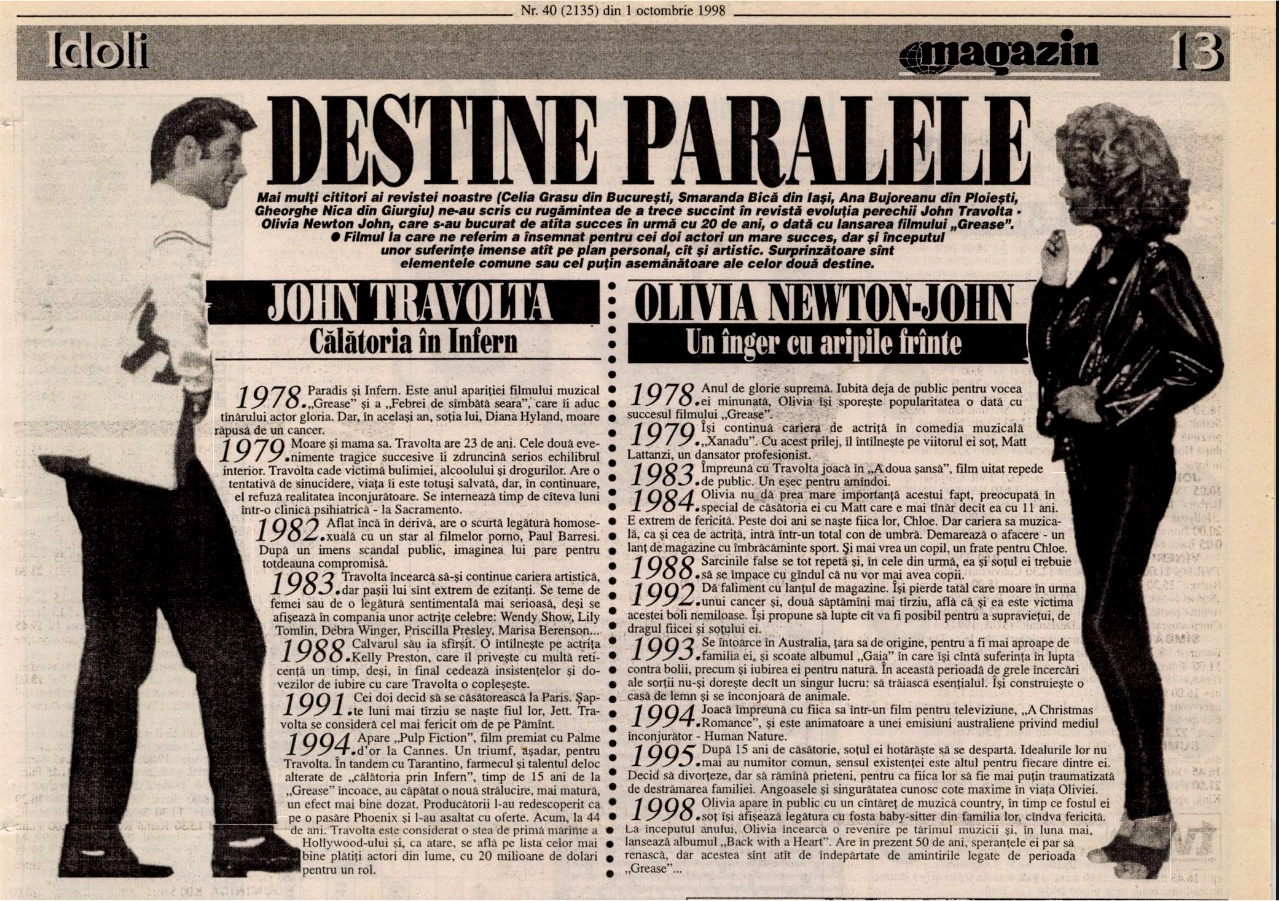
Translation from Romanian - First Article, Sept 24 1998:
OLIVIA NEWTON-JOHN An angel with broken wings
1978: Already loved by the public for her wonderful voice, Olivia increased her popularity with the success of the film Grease
.
1979: She continues her acting career in the musical comedy Xanadu
. On this occasion, she meets her future husband, Matt Lattanzi, a professional dancer.
1983: Together with Travolta stars in A Second Chance
, a film quickly forgotten by the public. A failure for both.
1984: Olivia doesn't give much importance to this fact, mainly concerned with her marriage to Matt, who is 11 years younger than her. She is extremely happy. Two years later their daughter, Chloe, is born. But her musical career, like her acting career, enters a decline. She starts a business a chain of sportswear stores. And she wants another child, a brother for Chloe.
1988: Miscarriages keep happening and, eventually, she and her husband have to come to terms with the fact that they will never have children again.
1992: She goes bankrupt with her chain of stores. She loses her father to cancer and, two weeks later, she finds out that she too is a victim of this ruthless disease. She decides to fight as hard as she can to survive, for the sake of her daughter and her husband.
1993: She returns to Australia, her country of origin, to be closer to her family, and releases the album, Gaia
, in which she sings of her suffering in the fight against the disease, as well as her love for nature. During this period of difficult trials of fate, she only wants one thing: to live the essentials. She builds a wooden house and surrounds herself with animals.
1994: She stars with her daughter in a television movie, A Christmas Romance
, and is the host of an Australian environmental show, Human Nature
.
1995: Although each of them still has a common goal, the meaning of life is different for each of them. They decide to divorce, but to remain friends, so that their daughter is less traumatized by the breakup of the family. Anxieties and loneliness reach their peak in Olivia's life.
1998: Olivia appears in public with a country music singer, while her ex-husband flaunts his affair with their once happy family's former babysitter. At the beginning of the year, Olivia attempts a comeback in the music world. In May, she releases the album Back with a Heart
. She is now 50 years old, her hopes seem to be rekindled, but they are so distant from the memories of the Grease period.
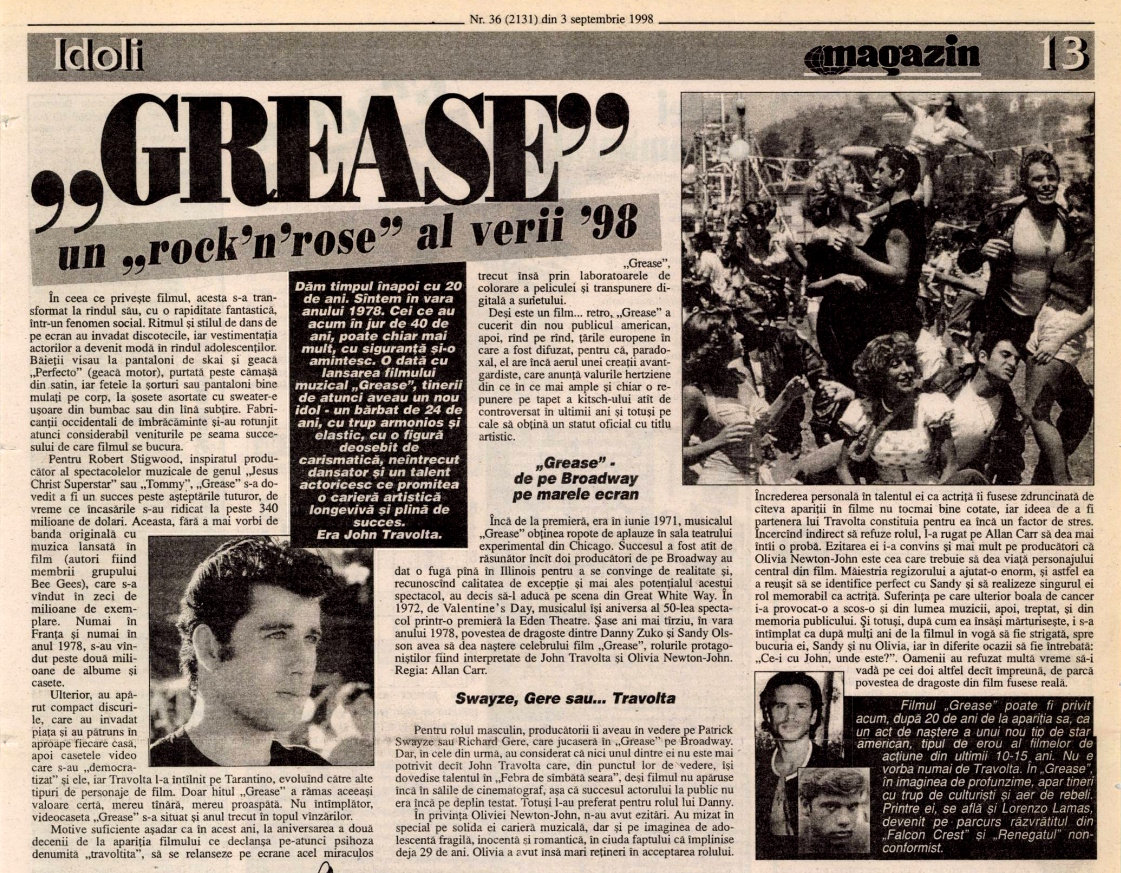
Translation from Romanian - Second article: September 3 1998
Grease: a rock'n'rose
of the summer of '98
Let's go back 20 years. It's the summer of 1978. Those who are now around 40, maybe even older, certainly remember it. With the release of the musical film Grease
, the youth of that time had a new idol - a 24-year-old man with a harmonious and elastic body, a particularly charismatic figure, an unsurpassed dancer and an acting talent that promised a long-lasting and successful artistic career. It was John Travolta.
As for the film, it transformed itself, with fantastic speed, into a social phenomenon. The rhythm and style of dance on the screen invaded discos, and the actors' clothing became fashionable among teenagers. Boys dreamed of leather pants and a Perfecto
jacket (motorcycle jacket), worn over a satin shirt, and girls of fitted skirts or pants, matching socks with light cotton or fine wool sweaters. Western clothing manufacturers then significantly increased their incomes from the success of the film.
For Robert Stigwood, the inspired producer of musicals like Jesus Christ Superstar
or Tommy
, Grease
proved to be a success beyond everyone's expectations, since the receipts amounted to over 340 million dollars. This, not to mention the original soundtrack released for the film (songwriters being members of the Bee Gees group), sold tens of millions of copies. In France alone and in 1978 alone, over two million albums and cassettes were sold. Later, compact discs appeared, which invaded the market and entered almost every home, then video cassettes which became popular.
Travolta also changed - Travolta met Tarantino, evolving towards other types of film characters. Only the hit Grease
remained the same value, always young, always fresh. Not coincidentally, the videotape Grease
was also in the top sales last year. Enough reasons, therefore, that this year, on the anniversary of two decades since the release of the film that triggered the psychosis called Travolta
, to relaunch that miraculous film on the screens
Grease, however, passed through the film coloring laboratories and digital transposition of the cartoon. Although it is a retro film, Grease
has once again conquered the American audience, then, one by one, the European countries in which it was broadcast, because, paradoxically, it still has the air of an avant-garde creation, which announces the increasingly broad radio waves (?) and even a re-emphasis on the kitsch that has been so controversial in recent years and is about to obtain an official artistic status.
Since its premiere in June 1971, the musical Grease
has been receiving thunderous applause in the experimental theater hall of Chicago. The success was so resounding that two Broadway producers went all the way to Illinois to convince themselves of the reality and, recognizing the exceptional quality and especially the potential of this show, decided to bring it to the stage of the Great White Way. In 1972, on Valentine's Day, the musical celebrated its 50th performance with a premiere at the Eden Theatre. Six years later, in the summer of 1978, the love story between Danny Zuko and Sandy Olson would give birth to the famous film Grease
, the roles of the protagonists being played by John Travolta and Olivia Newton-John. Directed by: Allan Carr.
For the male role, the producers considered Patrick Swayze or Richard Gere, who had starred in Grease
on Broadway. But, in the end, they considered that neither of them was more suitable than John Travolta, who, from their point of view, had proven his talent in Saturday Night Fever
, although the film had not yet appeared in cinemas, so the actor's success with the public was not yet fully tested. However, they preferred him for the role of Danny.
Regarding Olivia Newton-John, they had no hesitation. They relied especially on her solid musical career, but also on her image as a fragile, innocent and romantic teenager, despite the fact that she was already 29 years old. Olivia, however, had great reservations about accepting the role.
Her personal confidence in her acting talent had been shaken by a few appearances in not-so-well-rated films, and the idea of being Travolta's partner was another worry for her. Indirectly trying to refuse the role, she asked Allan Carr to give her a test first. Her hesitation convinced the producers even more that Olivia Newton-John was the one who should give life to the central character in the film. The director's mastery helped her enormously, and thus she managed to identify perfectly with Sandy and achieve her only memorable role as an actress. The suffering that the cancer disease later caused her removed her from the world of music, and then, gradually, from the public's memory. And yet, as she herself confesses, it happened to her that many years after the popular film, to her delight, she was called Sandy and not Olivia, and on various occasions she was asked: What's wrong with John, where is he?
People refused to listen to her for a long time, seeing the two of them differently than together, as if the love story in the movie had been real.
The film Grease
can now be seen, 20 years after its release, as an act of birth of a new type of American star, the type of hero of action films of the last 10-15 years. It's not just about Travolta. In Grease
, in the depth image, young people appear with bodybuilder bodies and a rebellious air. Among them, there is Lorenzo Lamas, who along the way became the rebel in Falcon Crest
and the non-conformist Renegade
.